Introduction
Maxillofacial injuries constitute a major global health concern due to the anatomical complexity and functional significance of the facial region. Their incidence and patterns vary widely across populations, influenced by social, cultural, environmental, and economic factors [1]. Owing to the exposed position of the face, these injuries are common and frequently associated with trauma to other organ systems, thereby increasing morbidity and complicating management.
Maxillofacial trauma refers to any physical injury involving facial soft tissues, bones, or both, occurring either in isolation or as part of polytrauma. Common causes include road traffic accidents, assaults, falls, industrial injuries, sports trauma, and animal bites. Among these, road traffic accidents remain a leading cause worldwide. The concept of the “golden hour” highlights the critical importance of timely intervention in reducing morbidity and mortality [2].
The anatomical location and fracture patterns depend on the mechanism and direction of injury, with the mandible being the most frequently fractured bone [3]. Due to the proximity of the facial region to the airway and cranial structures, maxillofacial trauma often presents with life-threatening complications, particularly airway compromise caused by hemorrhage, edema, foreign bodies, or fracture displacement [4]. Effective management requires prompt airway assessment, adherence to ATLS principles, and simultaneous cervical spine protection [5].
Diagnosis is based on detailed clinical examination supported by imaging modalities such as computed tomography, the gold standard for evaluation Failure to identify [6] and manage these injuries appropriately may lead to long-term functional and aesthetic impairment [7].
Presentstudy was conducted to study the epidemiology and patterns of isolated maxillofacial trauma, to study the cause of trauma, treatment modalities and complications in a tertiary care hospital.
Material and Methods
Present study was a prospective study conducted in the emergency of the Post Graduate Department of General Surgery of a tertiary care hospital. All the patients admitted with isolated Maxillofacial injury over a period of one year (1st August 2023 to 31st July 2024) were included in the study.
Inclusion Criteria
All the patients admitted through emergency under the Department of Surgery with isolated maxillofacial trauma
Exclusion Criteria
Patients with other associated injuries.
All the patients not consenting to be part of study
A sample size of 100 was obtained as per the inclusion and exclusion criteria from the admitted patients in the institution during the time frame of the study. The initial patient examination was performed by the attending surgeon. A consultation with the Maxillofacial surgeon, neurosurgeon or other specialities was sought where ever needed. Patients after admission were reviewed, the diagnosis and treatment planning was done and intervention done if required.
Patients with maxillofacial fractures were seen in the outpatient department or in the emergency room. Patients were primarily admitted to the hospital. The treatment option was planned as soon as the diagnostic results were available. Patients were diagnosed and operated wherever required. Antibiotics and pain medications were administered pre- and postoperatively. In case of orbital involvement, an examination by eye specialists was done. Patients were discharged after meeting the criteria for discharge. Patients after discharge were kept on regular follow up. Complications if any were managed adequately.
The institutional ethical committee clearance has been obtained. This study has been conducted in accordance with the rules and regulations set by IEC. Patients were interviewed in a separate room assuring anonymity. They were assured that their participation in the study will not affect their treatment plan.
Results
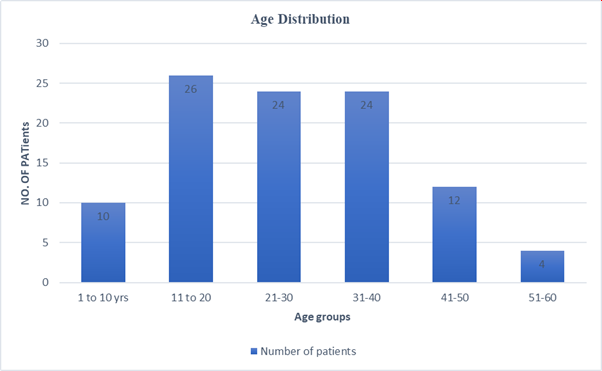
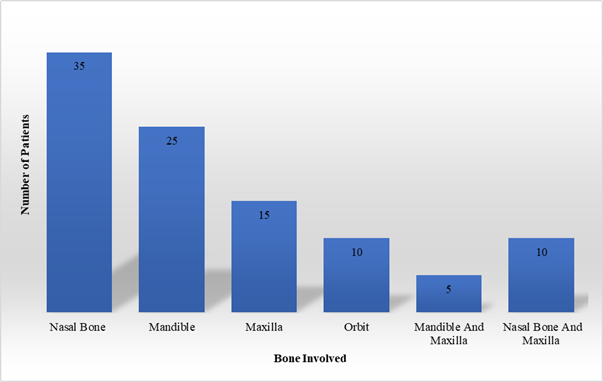
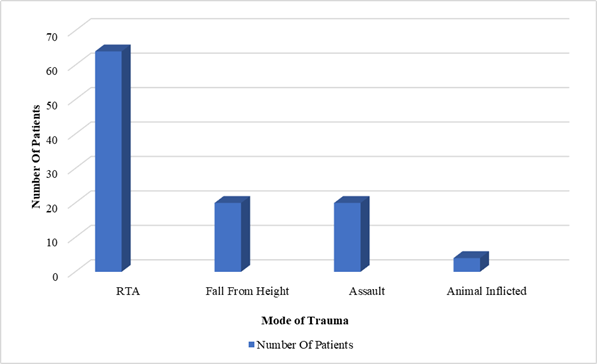
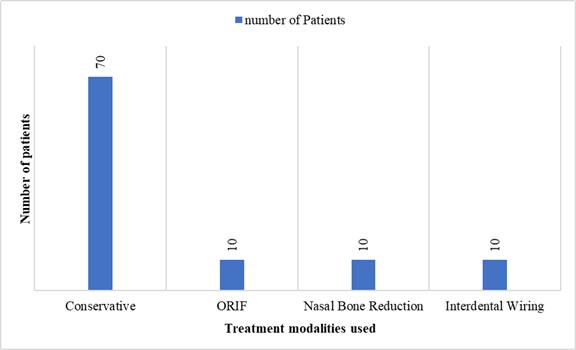
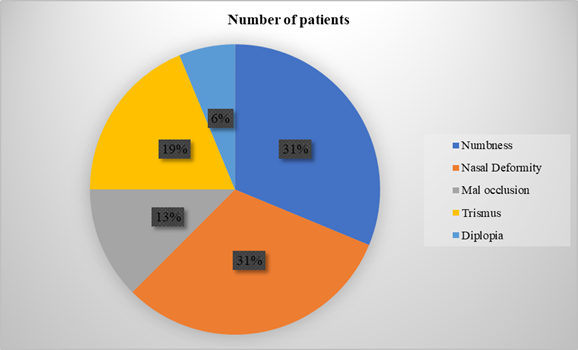
In the study, median age of patients was 26 years. Maximum number of patients were in the age group 11-20 years accounting for 26% of total cases. 10 patients were in the age group 1-10 years; 26 patients were in the age group of 11-20 years; 24 patients were in the age group of 21-30 years; 24 patients were in the age group of 31-40 years; 12 patients were in the age group of 41-50 years and 4 patients were in the age group of 51-60 years. Male to female ratio was 4:1. Maximum number of Patients (36%) were College going students, whereas farmers contributed to 24% as depicted in Table 1 and fig 1. Out of a total of 100 Patients, Isolated Nasal bone fracture was found in 35%; Isolated mandible fracture in 25%; Isolated maxilla fracture in 15%; Isolated fracture of Orbit in 10% of total cases. Combined Nasal bone and Maxilla fractures were found in 10% and combined Maxilla and Mandible fractures were seen in 5% of cases (Table 2, Fig 2). Figure 3 shows that Road Traffic Accident was the most common cause of maxillofacial injuries accounting for 64% of the total cases followed by fall from height (20%), assault (12%) and animal inflicted injuries accounting for 4% 0f the cases. Nasal bone fractures were seen in 35 patients. 15 patients had type 1 nasal bone fracture, 15 patients had type 2 nasal bone fracture and 5 patients had type 3 nasal bone fracture. Mandible fractures were seen in 25 patients out of which 15 patients had parasymphyseal fractures, 5 patients had fractures of body of mandible, 3 patients had fractures of condyle of mandible and 2 patients had fracture of angle of mandible. 15 patients had fracture of maxilla out of which 10 patients had Lee Fort 1 fracture and 5 patients had Lee Fort 2 fracture. Orbital fractures were seen in 11 patients out of which 5 patients had fracture of floor of orbit, 3 patients had fracture of lateral wall of orbit, 2 patients had fracture of medial wall of orbit and 1 patient had fracture of floor of orbit (Table3). Non Contrast CT of face was the most common diagnostic modality used for diagnosis of maxillofacial injuries. 70% of the cases were diagnosed using NCCT face. Roentgenogram of face was useful in diagnosing 20% of the patients with maxillofacial injuries (especially in cases of nasal bone injuries). 10% of patients of maxillofacial injuries in our study were diagnosed using Orthopantomogram as depicted in table 4. 70% of maxillofacial injuries were managed conservatively. Open reduction and internal fixation was the treatment modality in 10% cases. Nasal bone reduction (closed) was done in 10% of total cases. Interdental wiring was done in 10% of cases (Table 5, Figure 4). Out of a total of 100 patients, post treatment complications were encountered in 15% of the patients during follow up. The most common post treatment complication encountered was numbness over the cheek particularly in cases of maxillary fractures. Nasal deformity was second most common post treatment complication encountered in 4% of cases. Trismus was seen in 3% cases of mandibular fracture which were treated by Heisters Mouth prop. Malocclusion was seen in 2 cases of mandibular fracture which were later managed by orthodontist. Diplopia was present in one case of orbital floor fracture which was managed conservatively. This data is graphically represented in figure 5.
| Variable | No. of Patients(N=100)(N) | Percentage(%) |
| Age group in years | ||
| 1-20 | 36 | 36 |
| 21-40 | 48 | 48 |
| 41-60 | 16 | 16 |
| Gender | ||
| Male | 80 | 80 |
| Female | 20 | 20 |
| Residence | ||
| Urban | 70 | 70 |
| Rural | 30 | 30 |
| Occupation | ||
| College Going | 36 | 36 |
| Office workers | 14 | 14 |
| Farmers | 24 | 24 |
| School Going | 10 | 10 |
| House Wife | 12 | 12 |
| Labourer | 04 | 04 |
| Bone Involved | Number of Patients (N) (N=100) | Percentage (%) |
| Nasal Bone | 35 | 35 |
| Mandible | 25 | 25 |
| Maxilla | 15 | 15 |
| Orbit | 10 | 10 |
| Nasal Bone and Maxilla | 10 | 10 |
| Mandible and Maxilla | 5 | 5 |
| Bone Involved | Type of Fractures | No of Cases |
| Nasal Bone Fractures | Type 1 | 15 |
| Type 2 | 15 | |
| Type 3 | 5 | |
| Mandible Fractures | Parasymphyseal | 15 |
| Body Of Mandible | 05 | |
| Condyle Of Mandible | 3 | |
| Angle Of Mandible | 2 | |
| Maxilla | Lee Fort 1 | 10 |
| Lee Fort 2 | 5 | |
| Orbit | Floor of Orbit | 5 |
| Lateral wall | 3 | |
| Medial Wall | 2 | |
| Orbital Floor | 1 |
| Variable | No. of Patients(N=100)(N) | Percentage (%) |
| CT Face | 70 | 70% |
| Roentgenogram Face | 20 | 20% |
| Orthopantomogram. | 10 | 10% |
| Management | No of Patients (N=100) (N) | Percentage(%) |
| Conservative | 70 | 70 |
| ORIF | 10 | 10 |
| Nasal Bone Reduction | 10 | 10 |
| Interdental wiring | 10 | 10 |
Discussion
Maxillofacial region being the most exposed part of the body is highly susceptible to trauma. Globally, the primary causes of maxillofacial injuries include interpersonal violence, road traffic accidents, falls, and sports injuries. Road traffic accidents (RTAs) are a significant contributor to both mortality and morbidity worldwide, particularly in developing countries. The prevalence of maxillofacial injuries is variable, with the variation attributed to factors such as environmental conditions, socioeconomic status, cultural practices, and traffic regulations.
Median age of patients included in our study group was 26 years. Maximum number of patients were in the age group 11-20 years accounting for 26% of total cases. Singaram M et al., (2016)[8] in their study Prevalence, pattern, etiology, and management of maxillofacial trauma in a developing country reported that adults between 20 to 40 years of age were more commonly involved and mean age of the patients included was 35 years. In a study by Aleksanyan LV et al., (2022)[9] adults aged between 21 and 40 years had the highest rate.
Out of a total of 100 patients, 80 were males and 20 were females Male to female ratio was 4:1. Cabalag MS et al., (2014)[10] in their study Epidemiology and management of maxillofacial fractures in an Australian trauma centre reported that Males were more frequently affected accounting for 80% of the population and females accounting for 20% of the population. This study goes well with our observation. Gupta P et al.,(2023)[11] in their study of Maxillofacial Fractures at a Tertiary Care Centre in North India: A Review of 1674 Cases concluded that and males were more frequently affected (80.3%) with male to female ratio of 4.7:1. This study goes well with our observation.Out of a total of 100 patients who sustained maxillofacial injuries in our study group, 70(70%) belonged to urban areas whereas 30 (30%) belonged to rural areas.Vaibhav N et al., (2021)[12] in their study Maxillofacial Injuries as an Occupational Hazard of Farming in Rural and Semi-urban Population: A 3-Year Retrospective Epidemiological Study concluded that rural population was more prone to maxillofacial injuries due to farming as compare to semiurban population.
Maximum number of Patients (36%) were College going Students followed by farmers (24%) in the present study, Singaram M et al., (2016)[8] in their study concluded that the incidences of maxillofacial injuries were more commonly seen in school going children. Among children below the age of 15 with injury due to falling while playing, the injury was mild, causing only soft tissue laceration or dentoalveolar or tooth fracture, rather than being a severe injury. Kuriadom ST et al., (2021)[13] found that most commonly affected persons were the pedestrians, followed by the drivers, passengers, motorcyclists, and cyclists.
Out of a total of 100 Patients, Isolated Nasal bone fracture was found in 35% cases, Abhinav RP et al., (2019)[14] reported that 64% patients had had isolated lower facial fractures (19%). Gupta P et al.,(2023)[11] found that Mandibular fractures accounted for 38% of all fractures, with the parasymphysis being the most common site for fractures. Alvi A et al., (2003)[6]concluded that Orbital fracture was the most common overall facial fracture (24.2%), with nasal fractures being the most common isolated fracture (23.2%).
In our study group, RTA was the most common cause of maxillofacial injuries accounting for 64% of the total cases followed by fall from height (20%), Alvi A et al., (2003)[6] reported that the most common cause of facial fractures was assault (41%), followed by motor vehicle accident (26.5%). Arslan ED et al., (2014)[15] observed that the most common cause of injuries were violence, accounting for 39.7% of the sample, followed by falls 27.9% and road traffic accidents 27.2%.
Nasal bone fractures were seen in 35 patients. 15 patients had type 1 nasal bone fracture, 15 patients had type 2 nasal bone fracture and 5 patients had type 3 nasal bone fracture in our study, Kuriadom ST et al., (2021)[13] in their study Incidence of maxillofacial fractures in motor vehicle accidents treated in Dubai concluded that Unilateral mandibular fractures (56.4%) were more common than bilateral mandibular fractures (43.6%). Eighteen cases of mandibular and maxillary dentoalveolar fractures were reported.
In our study group 70% of maxillofacial injuries were managed conservatively. Open reduction and internal fixation was the treatment modality in 10% cases. Nasal bone reduction (closed) was done in 10% of total cases. Kar IB et al., (2016)[16] concluded that Soft tissue injuries were managed by simple debridement and primary closure in 75% of cases. The majority of bony injuries were managed with open reduction and internal fixation by either miniplate fixation or trans-osseous wire fixation (78.9% of the cases). Maxillo-mandibular fixation was used in the rest of the cases as a treatment modality for bony injury. Two cases required local or regional flaps for tissue coverage, while three cases required free tissue transfers for reconstruction of the defects.
Ansari MH (2004)[17] in their study observed that Naso-frontal fractures were treated with open reduction and trans-osseous wiring. Nasal complex fractures were treated with closed reduction and supported by plaster of Paris splints and nasal packing.
Out of a total of 100 patients, post treatment complications were encountered in 15% of the patients during follow up. The most common post treatment complication encountered was numbness over the cheek particularly in cases of maxillary fractures. Nasal deformity was second most common post treatment complication encountered in 4% of cases.
Kuriadom ST e et al., (2021) [13] concluded that, 18.4% of the patients had postoperative complications in which paresthesia was most common. Other complications included double vision and infection, flattening of the cheek, epiphora, and enophthalmus and limited mouth opening, nasal deformity, anterior open bite, permanent paresthesia, mandibular deviation, and telecanthus.
Kar IB et al., (2016)[16] in their study observed complications like parotid fistulas, hypertrophic scars and enopthalmus.
Conclusion
Maxillofacial injuries are very common among trauma patients especially in cases of Road traffic accidents. College going male students are the most commonly affected population. Although trauma management has advanced significantly, leading to reduced mortality rates within the golden hour, challenges still remain, particularly in managing maxillofacial injuries in polytraumatized patients. These injuries are critical because their proximity to the airway and brain poses an immediate threat to life.
Surgery for maxillofacial trauma, especially in cases involving extensive or complex fractures, remains challenging. Maxillofacial injuries often occur alongside other injuries, which may delay early surgical intervention and increase the risk of infection, non union, and malocclusion. This knowledge of epidemiology of maxillofacial injuries and utilities of diagnostic and treatment modalities along with post treatment complication profile will guide us to further strengthen our institutional protocols regarding the management of maxillofacial injuries.
Declaration
Acknowledgements
We are indebted to Department of General Surgery Government Medical College Jammu to allow us to conduct this study.
Conflict of Interest
None
Funding
Nil
Contributors
Dr Raja Langer, Assistant Professor of Surgery Government Medical College Jammu, J&K UT, India.
Dr Atta UL Rehman senior resident department of Surgery Government Medical College Jammu, J&K UT, India.
Dr Ratnakar Sharma, Professor and Head, Department of Surgery, Government Medical College Jammu, J&K UT, India.
Ethical Clearance
Taken
Trial Details
Not Applicable