Introduction
Cancer is a disease in which part of the body’s cells grow in an abnormal pattern and spread to other parts of the body [1]. The tumour-node-metastasis (TNM) system is the most common way doctors use to stage tumours based on clinical and pathological criteria. At the same time, grading describes the size and spread of cancer [2].
In 2022 globally, 2.3 million new cases and 670,000 deaths from female breast cancer [3]. Breast cancer in Sudan affects 3.9 cases per 100,000 women, with invasive breast carcinoma of no special type being the commonest. North Sudan reported the highest incidence [4]. First-line investigation of a breast lump follows the triple assessment protocol, which includes clinical examination, imaging and tissue biopsy [5]. There are benign and malignant types of tumours. Benign tumours do not spread throughout the body and usually do not recur after surgery. The malignant tumours invade the tissue around the breast, and the cancer cells can spread and invade other body organs, causing the development of metastasis, one of several complications that can cause the patient to die [6]. Early cancer detection is a challenge in treating cancer patients; remarkably, carcinomas of the breast, lung, liver, pancreas, ovary, and colon contribute to more than 50% of total incidences and mortality annually, which could be reduced by early detection, as mucins are highly upregulated during the early progression of these cancers [7]. Additionally, the mucin family is a large family of proteins with extensive glycosylation, and it can be classified into membrane-bound and secretory types. The mucins form a chemical barrier on the luminal surfaces of organs such as the breast, pancreas, and gastrointestinal tract, protecting against infection and inflammation. As essential components of cells, mucin proteins also play important roles in cellular apoptosis, adhesion, and metastasis. It has been reported that mucins serve as specific diagnostic markers and therapeutic targets in human cancers [8]. Mucins regulate diverse cellular activities in both normal and pathological conditions. Mucin acts through its interactions with proteins and some other mechanisms.
Mucin plays a crucial role in tumour progression and invasion, as well as in protection against the host immune response. It is necessary to assess the mucin level technique for the diagnosis of breast cancer [9]. Mucin is classified into neutral and acidic mucins, distinguished by their histochemical characteristics [10]. The acid and neutral are separated using the combined Alcian blue and PAS technique; this technique is also useful as a routine demonstration of mucin [11].
This study aims to evaluate mucin histochemical expression in female breast tumours using Alcian blue and PAS staining.
Materials and Methods
This study was conducted from June to August 2024, at the National Health Insurance Fund in Kosti City, White Nile State, Sudan. Ethical approval was obtained from the Ethical Committee of the University of El-imam El Mahdi, and from the National Health Insurance Fund.
The sample was collected from the National Health Insurance Fund, White Nile State—a total of archive tissue specimens obtained from the surgical biopsy removed.
The breast biopsy was instantly fixed in 10% formaldehyde and embedded in paraffin wax. Sections were cut 4-5 micrometres in thickness and then stained.
Statistical analysis
The data obtained were computerised and analysed using the Statistical Package for the Social Sciences (SPSS) version 21 (IBM Corp.). The chi-squared test assessed the data. Data were expressed as mean (m) with standard deviation (SD), percentage, and frequency. A p-value of < 0.05 was considered significant.
Results
Table (1): showed that total number of samples was 60, benign tumors was found in 46 samples (77%) and malignant tumour in 16 samples (23%), 45 samples of benign expressed combination of acid and neutral mucins except one sample was neutral mucin only, while malignant tumors expressed neutral mucin only except two samples expressed combination of acid and neutral mucins.
Table (2): showed that more common type of tumors was fibroadenoma in 23 samples (38.3%) all expressed acid and neutral mucins, then fibrocystic change in 17 samples (28.3) also all expressed acid and neutral mucins, while filloid tumor, chronic mastitis, ductectasia, intraductal papilloma and ductal hyperplasia all was represented with one sample (1.7%) for each type and all expressed acid and neutral mucins, while atypical hyperplasia was found in one sample (1.7%) and expressed neutral mucin only. Invasive ductal carcinoma grade III was observed in seven samples (11.7%), while six samples (10%) expressed neutral mucin only, except for one sample (1.7%) that expressed both acid and neutral mucins. Invasive ductal carcinoma, grade II, was observed in 6 samples (10%), all of which expressed neutral mucin only. In contrast, lobular carcinoma was represented by a single sample, which expressed both acid and neutral mucins, whereas hyperplasia expressed neutral mucins only.
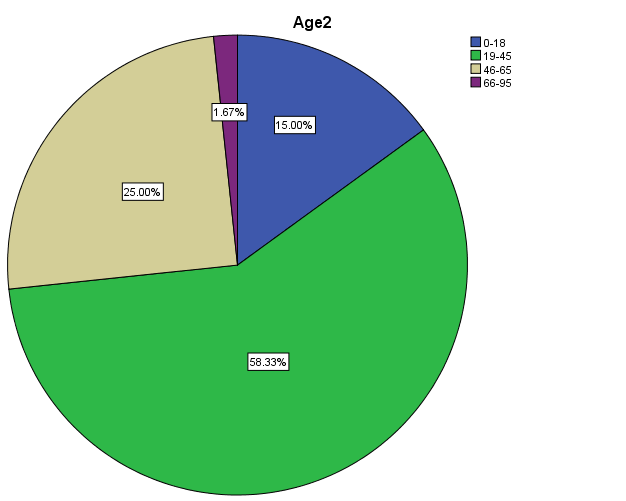
Figure (1): Age distribution, which divided the females into age groups (0 to 18 years old) represented (15%), (19 to 45 years old) represented (58.3%), (46 to 65 years old) represented (25%), and (66 to 95 years old) represented (1.67%).
Table (3) Age group (0 to18 years old ) female in puberty age was nine samples all was benign tumors, group (19 to 45years old ) female in fertility age was 35 samples in which 24 samples was benign tumors while other 11 samples was malignant tumors, group (46 to 65 years old) female in menopausal age was 15 samples in which 12 samples was benign tumors and 3 samples was malignant tuomrs, group (66 to 95 years old ) female in postmenopausal age was one sample and it was benign tumor.
| Type of Tumor | Mucin type | Total | |
| Acid and neutral Frequency (%) | Neutral only Frequency (%) | ||
| Benign | 45(75%) | 1(1.7%) | 46(76.7%) |
| Malignant | 2(3.3%) | 12(20%) | 14(23.3%) |
| Total | 47(78.3%) | 13(21.7%) | 60(100%) |
| p-value | 0.000 |
| Diagnosis | Mucin type | Total | |
| Acid and neutral Frequency (%) | Neutral only Frequency (%) | ||
| Fibroadenoma | 23(38.3%) | 0(0%) | 23(38.3%) |
| Filloid tumor | 1(1.7%) | 0(0%) | 1(1.7%) |
| Chronic mastitis | 1(1.7%) | 0(0%) | 1(1.7%) |
| Fibrocysitc change | 17(28.3%) | 0(0%) | 17(28.3%) |
| Ductectasia | 1(1.7%) | 0(0%) | 1(1.7%) |
| Intraductal papilloma | 1(1.7%) | 0(0%) | 1(1.7%) |
| ductal hyperplasia | 1(1.7%) | 0(0%) | 1(1.7%) |
| lobular carcinoma | 1(1.7%) | 0(0%) | 1(1.7%) |
| invasive ductal grade 2 | 0(0%) | 6(10%) | 6(10%) |
| invasive ductal grade 3 | 1(1.7%) | 6(10%) | 7(11.7%) |
| atypical hyperplasia | 0(0%) | 1(1.7%) | 1(1.7%) |
| Total | 47(78.3%) | 13(21.7%) | 60(100%) |
| p-value | 0.000 |
| Status | Age group | Total | |||
| 0 – 18 | 19 - 45 | 46 - 65 | 66 - 95 | ||
| Benign | 9(15%) | 24(40%) | 12(20%) | 1(1.7%) | 46(76.7%) |
| Malignant | 0(0%) | 11(18.3%) | 3(5%) | 0(0%) | 14(21.3%) |
| Total | 9(15%) | 35(58.3%) | 15(25%) | 1(1.7%) | 60(100%) |
| p-value | 0.220 |
Discussion
Cancer is now becoming a significant public health problem globally [13]. Among all the types of cancers, breast cancer represents the most prevalent invasive cancer in females, affecting around 14% of women during their lifetime worldwide and causing approximately 500,000 deaths yearly [14]. Breast cancer is the most frequent malignancy in Sudan [15].
The study was carried out in the Sudan White Nile State, Kosti city, at the National Health Insurance Fund in 2024. This cross-sectional study includes 60 subjects. The results showed that benign tumours were the commonest (76.7%) and malignant tumours represented 23.3% of the total of 60 samples.
Results showed that the frequency of benign tumours was: fibroadenoma (38.3%), fibrocystic change (28.3%), follicular tumour, chronic mastitis, ductectasia, ductal hyperplasia, intraductal papilloma, and atypical hyperplasia (1.7% each). This was supported by Hussein et al.,2022[16], who found that the most frequent type of breast tumour was fibroadenoma, followed by fibrocytic change. Additionally, the results showed that the frequency of malignant tumours was as follows: ductal carcinoma, grade II (10%), ductal carcinoma, grade III (11.7%), and lobular carcinoma (1.7%). This finding was supported by Atif A. Hashmi et al.,(2021) [17], who found that grade II is more common than grade III. A study conducted by Omer Abdelbagi in 2023[18] showed that almost all his studied cases were invasive ductal carcinoma, and the majority were grade II.
Additionally, all benign tumours expressed a combination of acidic and neutral mucins, except atypical hyperplasia, which was composed of neutral mucin only. In contrast, the malignant tumours expressed neutral mucin, except for two samples, which expressed a combination of acid and neutral mucin, one of which was a lobular carcinoma. The other was ductal carcinoma, grade III, which depended on genetic and distribution variations. This finding was supported by Tagwa S. Abdihalim et al., (2022) [17], who found that most breast cancer tumours expressed acidic and neutral mucin, whereas others expressed neutral mucin only. Additionally, the study by Primariadewi R et al., (2020) [19] found that most breast carcinomas expressed only neutral mucin. The study reveals a discrepancy with the survey conducted by Tagwa S. Abdihalim et al., (2022) [17], which found that 70% of malignant tumours were composed of acid mucins only, 5% were a combination of acid and neutral mucins, and 25% were neutral mucins only.
Conclusion
This study shows most of breast tumour cases were benign tumours and 23.3 % were malignant tumours. The female from puberty until menopausal age more infected with benign tumors. At the same time, females of reproductive age are more susceptible to malignant tumours.
The study shows that most benign tumours express a combination of acidic and neutral mucins, while most malignant tumours show neutral mucin only.
Declarations
Ethics approval and consent to participate
Ethical approval to conduct the study was secured from the Institutional Review Board of the Deanship of Scientific Research, Elimam Elmahdi University, Sudan.
Consent of Publication
Consent to participate in the study was taken verbally from each participant.
Acknowledgement
We would like to acknowledge all participants in the study.
Conflicts interests
All authors declare that there are no conflicts of interest.
Funding Statement
None