Introduction
Although percutaneous nephrolithotripsy (PCNL) is the accepted first-line treatment for renal stones ≥2 cm, retrograde intrarenal surgery (RIRS) has become increasingly popular for upper tract stones over the last decade owing to better safety profile and repeatability [1,2]. Technological innovations leading to improvements in design and availability of refined auxiliary instruments have resulted in higher stone-free rates making RIRS an acceptable alternative to PCNL even for larger stones [2-6]. However, superiority of RIRS over PCNL in the management of renal stones remains controversial to this date.
Stone free rates for RIRS have ranged from 50% to 94.2%.7 The inconsistency in the extraction rates could be attributed to the longer learning curves, variable anatomy and type/method of stone extraction [7,8]. Technique of stone extraction involves either “Basketing” or “Dusting” [9-11]. Dust and go is preferred for larger stones while fragmentation and basketing is the most often technique performed [9-11]. Stone retrieval after fragmentation is done either by the operative surgeon or the surgical assistant, with no consensus on who should ideally handle the basket. On literature search, we found lack of data pertaining to stone free rates with surgeon extraction of stone. Hence we designed a study to compare the outcomes following stone extraction between the operating surgeon and his assistant. The aim of this study is to prospectively compare assistant extraction and surgeon extraction in terms of operative and clinical outcomes.
Materials and Methods
After obtaining institutional ethical committee clearance for the study protocol, this prospective study was conducted between August 2024 and August 2025. All consecutive patients visiting our outpatient clinic with a diagnosis of renal stones and planned for RIRS as per the treatment guidelines, after detailed discussion with the primary consultant regarding the pros & cons, were included in the study.
Inclusion criteria were: Age >18yrs, Absence of UTI, stone size <2cm in the renal pelvis and <1cm in the lower calyx.
Exclusion criteria included: B/L procedure in the same sitting, Multiple sittings of the same procedure, presence of previous or concurrent GU tract malignancy, prior or concurrent genitourinary tuberculosis, and h/o reconstructive urinary tract procedures.
Initial evaluation included a detailed clinical history followed by clinical examination; ultrasonography of the kidney, ureter, and bladder (KUB) region for the initial diagnosis of stone disease, complete haemogram; serum creatinine; serum electrolytes; urine analysis and urine c/s ; followed by a contrast enhanced CT KUB to confirm the stone location, stone size, stone density measured as Hounsfield units, presence or absence of hydronephrosis , parenchymal thickness, presence or absence of ureteric obstruction. First twenty cases of M-arm were excluded to account for learning curve with new accessory. All eligible patients were then randomised to one of the two groups. Group A, underwent RIRS with stone extraction by the assistant i.e., ASSISTANT EXTRACTED(AE); and Group B, underwent RIRS with surgeon performing the stone extraction i.e., SURGEON EXTRACTED(SE). Randomisation was done in a 1:1 ratio using a sealed envelope sequence and the methods used for stone extraction were approved by the institutional review board.
A pre-anaesthetic evaluation was conducted before admission/procedure in all patients. All patients were admitted to the hospital on the day of the proposed surgery after fasting for 6 h.
Informed written consent for the proposed procedure was taken, followed by part preparation in the preoperative room just before the procedure. Appropriate antibiotic was administered intravenously from the time of initiation of anaesthesia until post-operative day one in those deemed culture negative preoperatively. For patients with a positive urine culture, a full course of antibiotics were given based on the sensitivity and the procedure was planned once the culture was sterile.
Surgical Technique: All procedures were performed under general anaesthesia and in dorsal lithotomy position. We first performed a cystoscopy to exclude intravesical lesions. Following cystoscopy, 6/7.5 Fr and 8/9.5 Fr semi rigid ureteroscope were used to dilate the ureter. For patients who were pre-stented, dilation was done with 8/9.5 Fr semi rigid scope. Ureteral access sheath (9/11fr) was placed over a guidewire under fluoroscopic guidance in all cases to facilitate stone extraction and also to reduce intrarenal pressure during surgery. A flexible ureteroscope (7.5Fr, KARL STORZ) was negotiated upto renal pelvis and stones the fragmented with 350um Holmium: yttrium laser (SPHINX) with a power of 1-1.5 Joules at a frequency of 10-15 Hz. Lower pole calculi were repositioned to a more comfortable pole or to the renal pelvis before fragmentation. Stones were retrieved using 1.5Fr tipless nitinol baskets (N Circle; COOK Medicals) for all procedures. For the SE group, extraction of stones was performed with the assistance of M-Arm (MC medical, Tokyo, Japan) which is a basket holder attached to the ureteroscope (Figure 1). The advantage of M-arm is that surgeon himself can manipulate the basket for stone retrieval. Following completion of the procedure, a ureteral stent was placed postoperatively only if one of the following criteria was met: likelihood of second procedure in view of residual stone or inaccessible stone, operative time > 60 mins, presence of pelvic wall oedema or ureteric tightness. A 16 Fr Foley’s urethral catheter was placed and removed on first postoperative day for all cases. Any complications in the postoperative period were noted and dealt with accordingly.
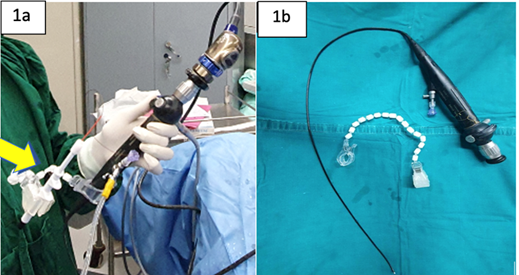
Intraoperative and postoperative factors were assessed for intraoperative time, length of post-operative stay and presence of post-operative residual stones. Stone free status (primary outcome) was defined as the absence of visible stone fragments on NCCT KUB films obtained 4-6 weeks from the date of stent removal. Non stented patients were assessed for stone free status NCCT KUB 4-6 weeks after RIRS (fURSL). All NCCT KUBS were assessed by single urologist with radiology assistance.
Statistical Methods:Descriptive analysis was carried out by mean and standard deviation for quantitative variables, frequency and proportion for categorical variables. Categorical outcomes were compared between study groups using Chi square test /Fisher's Exact test. A P value < 0.05 was considered statistically significant. IBM SPSS version 22 was used for statistical analysis.
Results
Of the 255 patients diagnosed with renal stones and posted for RIRS, 48 were excluded from the study as they didnot fit the inclusion criteria. 12 patients dropped out of the study following randomisation as they opted to get operated at a different centre. A total of 195 eligible subjects were included in the final analysis of which 90(46.2%) were in the ASSISTANT EXTRACTED and 105(53.8%) were in the SURGEON EXTRACTED group.
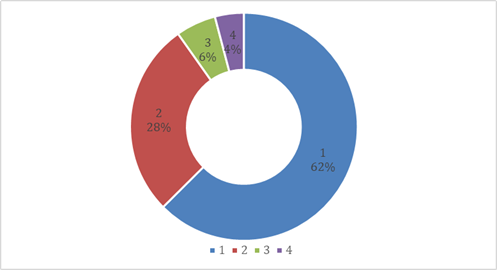
Mean age of the study population was 47.03± 13.64 years; mean serum creatinine level was 0.94 ± 0.27mg/dL, mean (SD) haemoglobin level was 13.08 ± 1.33 g/dL. The demographic profiles of the study population across both groups were comparable as represented in Table 1. Pelvic stones were more common in the SE group, although the difference was not statistically significant. The number of calculi noted in the kidney ranged from 1 to 4 with 1(62%) being the most common. The mean operative timeof AE group was significantly higher than the SE group (56.06 ± 8.6 minutes vs 47.1 ± 9.47 mins, P value <0.001), despite there being no significant difference of Hounsfield unit between two groups (P value 0.808).
| Variables | Assistant Extracted (N=90) | Surgeon Extracted (N=105) | P Value | ||
| Age (in years) | 45.40 ± 11.75 | 48.67 ± 16.85 | 0.124 | ||
| Gender | Male | 55 (61.11%) | 72 (68.57%) | 0.276 | |
| Female | 35 (38.89%) | 33 (31.43%) | |||
| Stone location | Pelvis | Yes | 45 (50%) | 57 (54.29%) | 0.550 |
| No | 45 (50%) | 48 (45.71%) | |||
| Lower calyx | Yes | 45 (50%) | 48 (45.71%) | 0.550 | |
| No | 45 (50%) | 57 (54.29%) | |||
| Pre Op stenting | Yes | 36 (40%) | 47 (44.76%) | 0.503 | |
| No | 54 (60%) | 58 (55.24%) | |||
| Presence or absence of HUN | Yes | 37 (41.11%) | 44 (41.9%) | 0.911 | |
| No | 53 (58.89%) | 61 (58.1%) | |||
| Hounsfield (HU) | 1165.69 ± 166.73 | 1171.7 ± 176.41 | 0.808 | ||
| Operative time(minutes) | 56.06 ± 8.6 | 47.1 ± 9.47 | <0.001 | ||
| Duration of postoperative hospital stay (no of days) | 1.07 ± 0.25 | 1.06 ± 0.23 | 0.784 |
Population(n=195)
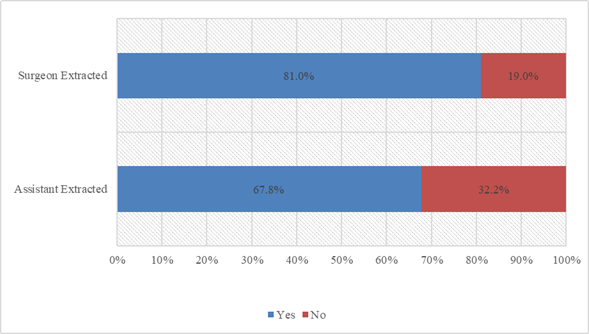
The stone-free rate was higher for the SE group than for the AE group (85 (80.95%) versus 61 (67.78%) respectively, 𝑃 < 0.001) (Figure 2) with postoperative length of stay comparable for both extraction methods. There were no cases in which surgeons switched from the SE to the AE method for stone extraction. Postoperative complications graded on modified Clavien classification system between both the groups were not statistically significant (Table 2).
| Grade | Complication | Assistant Extracted (N=90) | Surgeon Extracted(N=105) | P Value |
| I | Fever requiring antipyretics | 5 | 6 | >0.05 |
| Postoperative hematuria | 14 | 13 | >0.05 | |
| II | Fever requiring antibiotic/UTI | 3 | 4 | >0.05 |
| IIIb | Extravasation | 1 | - | >0.05 |
| IVb | Urosepsis | 1 | 1 | >0.05 |
Discussion
fURS in stones >20 mm is said to have lesser rate of complications and the shorter duration of hospitalization [12-14].The retreatment rates, however, seem to be higher with fURS as the stone burden increases [15]. The reason for this being residual fragments which may actually be representing a cluster of clinically insignificant fragments. Various technological advancements have been underway over the past decade to overcome the drawbacks of fURS,[15-18]one such deficiency being a smaller/limited working channel [19]. Smaller laser fibres are being preferred as they facilitate flexibility and fluid irrigation [20].Chen et al.,[21] aspirated the fragments directly by vacuum aspiration UAS while combining it with injection of saline to the distal end of the ureteral catheter, leading to a shorter operative time.
Earlier studies suggested that the presence of lower pole renal calculus is one the key factors predicting stone clearance status with fURSL [22].Steep anglulation between the axis of the inferior calyx and the ureteropelvic junction makes the access with flexi ureteroscope difficult [22,23].However, a study by Martin et al.,[24] has suggested that lower polar stone location had no impact on SFR. (p=0.224) which has been backed by many recent studies. Stone size larger than 10 mm and multiple stone locations were found to be associated with RIRS failure [25]. Other factors predictive of SFR include stone density measured as HU, abnormal anatomy, presence of ureteral access sheath and preoperative DJ stenting. Mulţescu et al.,[26] and Cho et al.,[19]have recommended dusting instead of fragmentation for stones larger than 1cm as the dust may hinder a clearly visualised operative field leading to difficulty in differentiating a small fragmented stone in the midst of dust.
Though various predictive factors for SFR have been looked upon and analysed, it was only Tadashi Tabei et al.,[27] in 2018, suggested the use of M-arm for stone extraction resulted in a significantly better SFR as compared to conventional stone extraction by the assistant using a nitinol basket. Presence of lower pole calculi was the only factor found to be predictive of a stone-free status in their study. We, however, did not find lower pole calculus to be a significant predictive factor. Repositioning of the lower calyceal stone into the pelvis prior to fragmentation may have resulted in improved SFR in our study. While Taibei et al.,[27] performed a retrospective analysis, ours is the only prospective study comparing the stone extraction using M-arm during fURS and Assisted extraction, with SE showing improved stone free rates as compared to AE. In contrast, we also noted a shorter operative time with the use of M-arm. This could be attributed to better coordination if the surgeon is handling the instrument rather than different assistants as the surgeon is better at deciding when to open and close the basket. Hence the rate of “missed pick up” is less with surgeon extraction. However the postoperative duration of hospital stay remained the same.
All the procedures were performed by a single experienced surgeon which could have attributed to a better SFR. The inexperience of using an M-arm did not seem to influence the outcomes and in fact was found to be beneficial. However, we did not consider the technical expertise of assistants involved in stone extraction in our analysis. Though the inexperience of assistants may have a huge impact on the outcomes of the AE approach, we ruled out the factor in view of our assistants being urologists with a decent surgical expertise.
Though our study achieves a higher stone free rate with surgeon extraction, larger cohorts are required for further validation of results.
Conclusion
fURSL with surgeon extraction of stone reduces the operative time and has higher stone free rates compared to conventional assisted extraction.
Declarations
Conflict of Interest
Nil
Acknowledgements
None