Introduction
Kaposi sarcoma (KS) is an angioproliferative neoplasm driven by human herpesvirus-8 (HHV-8) and is strongly associated with advanced HIV infection and immunosuppression [1]. In South Africa, KS remains among the most common HIV-associated malignancies, particularly in patients with delayed antiretroviral therapy (ART) initiation or poor adherence [2,3]. Clinically, KS presents with violaceous macules, plaques, or nodules involving the skin and may extend to mucosal or visceral sites [1]. Cutaneous disease may involve lymphatics, resulting in chronic lymphoedema and progressive fibrosis, which can lead to pain, ulceration and functional impairment [1,2]. While lymphoedema is a recognised complication of Kaposi sarcoma, its progression to severe fibrotic contractures with fixed deformities, particularly of the hand, is seldom reported in the literature.
Case presentation
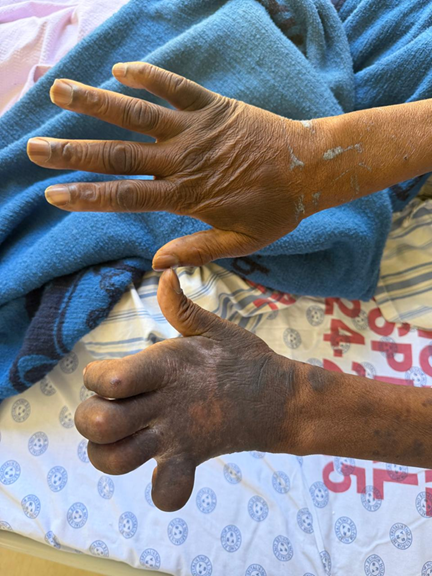
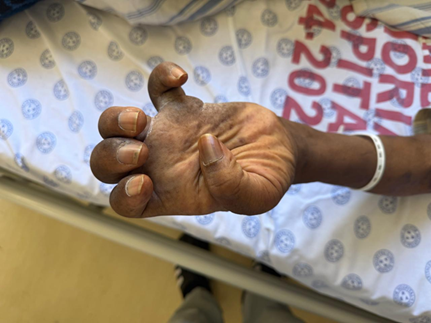
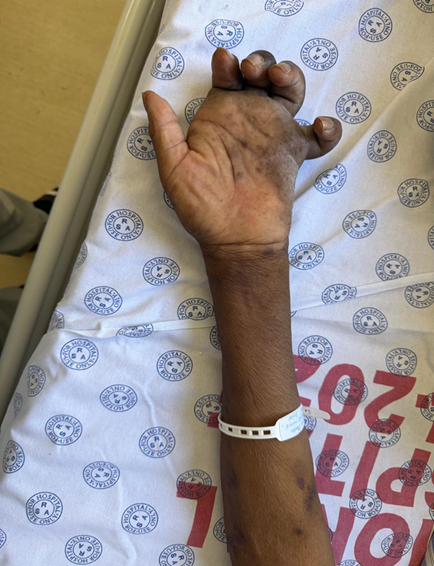
A 51-year-old HIV-positive male with a history of poor adherence to antiretroviral therapy presented with a 7-year history of progressive violaceous plaques and nodules over both upper limbs, more prominent on the left. There were no constitutional symptoms, including fever, weight loss, or night sweats. He denied any history of trauma or preceding injury. Examination revealed extensive cutaneous lesions consistent with Kaposi sarcoma, with severe fixed flexion contractures of the left hand and preserved function of the right hand despite similar lesions (Figure 1-3). No mucosal or visceral involvement was identified.
The deformity had developed gradually over several years. There were no clinical features to suggest alternative causes of ulnar deformity, including neuropathy, inflammatory arthropathy, or prior ischaemic injury. There were no clinical features of peripheral neuropathy. Laboratory investigations showed a CD4 count of 74 cells/µL, with a negative urine lipoarabinomannan assay (ULAM) and no evidence of concurrent opportunistic infection.
A skin biopsy demonstrated spindle cell proliferation with slit-like vascular spaces and extravasated red blood cells, confirming Kaposi sarcoma. There was no evidence of visceral or pulmonary involvement. The patient was restarted on antiretroviral therapy and referred to medical oncology at a tertiary institute for further management.
Discussion
Severe fixed flexion contractures in this patient may reflect the cumulative effects of long-standing, uncontrolled Kaposi sarcoma on soft tissue structure and function. Chronic Kaposi sarcoma lesions can evolve with persistent inflammation, oedema, ulceration, and fibrosis, leading to scarring, loss of tissue elasticity, and progressive shortening of periarticular soft tissues [4]. In addition, HHV-8-driven tumour biology may contribute to a profibrotic microenvironment. Viral oncogenic mechanisms in Kaposi sarcoma, including sustained inflammatory signalling and spindle-cell survival pathways, have been implicated in ongoing tissue remodelling that could favour irreversible contracture formation over time [5].
A major contributing pathway may be chronic lymphatic dysfunction. Kaposi sarcoma is linked to lymphatic obstruction and lymph stasis, which can produce persistent lymphoedema and a self-perpetuating cycle of inflammation and tissue hypertrophy [6]. Chronic lymphoedema may then promote local hypoxia. Hypoxic lymphatic endothelial responses have been associated with extracellular matrix rearrangement and fibrosclerosis, providing a biologically plausible mechanism for progressive soft tissue stiffening and deformity [7]. Recurrent superimposed infection may further amplify this process. In patients with HIV-related Kaposi sarcoma and chronic lymphoedema, cellulitis has been described as an additional source of inflammatory tissue injury that may worsen fibrosis and structural damage [8]. However, this patient reported no history of recurrent cellulitis. Additionally, abnormal extracellular matrix turnover may also be relevant, as matrix metalloproteinases have been implicated in both the progression and regression of Kaposi sarcoma, suggesting a role for dysregulated remodelling in chronic disease [9].
Taken together, these mechanisms suggest that a severe hand contracture in this case may have arisen from prolonged lymphatic compromise, chronic inflammation, fibrosis, and abnormal extracellular matrix remodelling in the setting of extensive, inadequately controlled disease. However, to our knowledge, this specific manifestation has not been clearly reported in the literature. The proposed association should therefore be regarded as a pathophysiological postulation rather than proof of causality, and further investigation is required.
Learning Points
Kaposi sarcoma may contribute to functional disability through chronic lymphoedema, inflammation, and fibrosis, although the exact mechanisms remain incompletely understood.
Severe fixed flexion contractures in this context may represent a late complication of prolonged, uncontrolled disease, potentially driven by progressive tissue remodelling and soft tissue shortening.
This presentation appears to be rarely described, and the observed association should be interpreted as a pathophysiological postulation rather than confirmed causality, warranting further investigation.
Conclusion
This case highlights a rare and severe presentation of Kaposi’s sarcoma associated with fixed flexion contractures of the hand. While a multifactorial process involving chronic lymphoedema, inflammation, and fibrosis is a plausible explanation, the relationship remains speculative. This observation underscores the potential for advanced, uncontrolled disease to result in significant functional impairment and highlights the need for further research to clarify the underlying mechanisms.
Declarations
Ethical Clearance
This study was conducted in accordance with the principles of the Declaration of Helsinki. Written informed consent was obtained from the patient for the use of anonymised clinical data and accompanying images for publication.
Acknowledgements
None
Conflict of interest
None
Funding/ financial support
None
Contributors
All authors contributed equally
Trial details
None