
Diagnostic Accuracy of Multiparametric MRI for Clinically Significant Prostate Cancer: A Systematic Review and Meta-Analysis
Authors

##plugins.themes.bootstrap3.article.sidebar##
##plugins.themes.bootstrap3.article.main##
Abstract
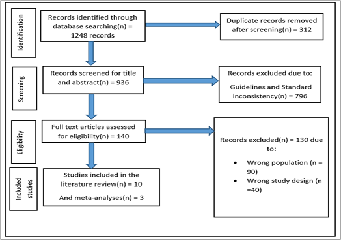
Background: Prostate cancer is still a primary cause of male cancer morbidity and mortality. Multiparametric MRI (mpMRI), based on PI-RADS interpretation, has become invaluable in the diagnosis of clinically significant prostate cancer (csPCa). Aim and Objective: To determine the diagnostic accuracy of mpMRI to identify csPCa when categorized based on cut-offs of PI-RADS score (≥3 and ≥4), and to examine consistency of reported results between and across studies and study-level heteroscedasticity. Methods: A systematic review and meta-analysis of PRISMA 2020 guidelines, including studies from 2017 to 2025, were undertaken. Ten studies that fulfilled the inclusion criterion, of which seven supplied quantitative data, were noted. Random effects models were used to calculate pooled sensitivity, specificity, and diagnostic odds ratio. Meta-regression was also undertaken to examine the relationship between effect size and standard error. Results: Pooled sensitivity for detection of csPCa was 0.84 (95% CI 0.80-0.88) and specificity was 0.72 (95% CI 0.66-0.78) at PI-RADS ≥ 4, and the AUC was 0.89. For PI-RADS ≥ 3, sensitivity became higher as 0.94, but specificity became lower as 0.45. Conclusion: The mpMRI enjoys high sensitivity and acceptable overall diagnostic effectiveness for the visualization of csPCa. Prospective advances that blend AI, Artificial General Intelligence, and multimodal data synthesis are likely to redefine prostate MRI from interpretive imaging to smart, precision-guided diagnosis.
##plugins.themes.bootstrap3.article.details##
Copyright (c) 2025 Vijayakumar Chinnasamy, Sanul Shahi K Salim, Nadha Rahim, Noula Rahim, Jamila Hameed

This work is licensed under a Creative Commons Attribution 4.0 International License.
Creative Commons License All articles published in Annals of Medicine and Medical Sciences are licensed under a Creative Commons Attribution 4.0 International License.
Vijayakumar Chinnasamy, Department of Radiology, Karuna Medical College, Vilayodi, Chittur, Palakkad, Kerala, 678103, India.
Department of Radiology, Karuna Medical College, Vilayodi, Chittur, Palakkad, Kerala, 678103, India.
Sanul Shahi K Salim, Department of Radiology, Karuna Medical College, Vilayodi, Chittur, Palakkad, Kerala, 678103, India.
Department of Radiology, Karuna Medical College, Vilayodi, Chittur, Palakkad, Kerala, 678103, India.
Nadha Rahim, Department of Radiology, Karuna Medical College, Vilayodi, Chittur, Palakkad, Kerala, 678103, India.
Department of Radiology, Karuna Medical College, Vilayodi, Chittur, Palakkad, Kerala, 678103, India.
Noula Rahim, Department of Biochemistry, Karuna Medical College, Vilayodi, Chittur, Palakkad, Kerala, 678103, India.
Department of Biochemistry, Karuna Medical College, Vilayodi, Chittur, Palakkad, Kerala, 678103, India.
Jamila Hameed, Research Mentor, Department of OBG, Karuna Medical College, Vilayodi, Chittur, Palakkad, Kerala, 678103, India.
Research Mentor, Department of OBG, Karuna Medical College, Vilayodi, Chittur, Palakkad, Kerala, 678103, India.
[1] Wang J, Chen M, Guo S, Xu Y, Liu L, Jiang X. Development and validation of biopsy free nomograms for predicting clinically significant prostate cancer in men with PI-RADS 4 and 5 lesions. Scientific Reports. 2025 Jan 20;15(1):2506.
[2] Jambor I, Verho J, Ettala O, Knaapila J, Taimen P, Syvänen KT, Kiviniemi A, Kähkönen E, Perez IM, Seppänen M, Rannikko A. Validation of IMPROD biparametric MRI in men with clinically suspected prostate cancer: a prospective multi-institutional trial. PLoS medicine. 2019 Jun 3;16(6):e1002813.
[3] Pacini M, Zucchi A, Morganti R, Dazzi F, Pastore AL, Valenzi FM, Fuschi A, Salhi YA, Giannarini G, Ficarra V, Simonato A. Correlation of clinically significant prostate cancer sites across multiparametric MRI, prostate biopsy, and whole-mount pathology for optimal prostate biopsy strategy. Scientific Reports. 2025 Feb 5;15(1):4310.
[4] Sakaguchi K, Hayashida M, Tanaka N, Oka S, Urakami S. A risk model for detecting clinically significant prostate cancer based on bi-parametric magnetic resonance imaging in a Japanese cohort. Scientific Reports. 2021 Sep 22;11(1):18829.
[5] Rosenkrantz AB, Ginocchio LA, Cornfeld D, et al. Interobserver Reproducibility of the PI-RADS Version 2 Lexicon: A Multicenter Study of Six Experienced Prostate Radiologists. Radiology. 2016;280(3):793-804.
[6] Daun M, Fardin S, Ushinsky A, Batra S, Nguyentat M, Lee T, Uchio E, Lall C, Houshyar R. PI-RADS version 2 is an excellent screening tool for clinically significant prostate cancer as designated by the validated international society of urological pathology criteria: A retrospective analysis. Current problems in diagnostic radiology. 2020 Nov 1;49(6):407-11.
[7] Ahmed HU, El-Shater Bosaily A, Brown LC, Gabe R, Kaplan R, Parmar MK, Collaco-Moraes Y, Ward K, Hindley RG, Freeman A, Kirkham AP, Oldroyd R, Parker C, Emberton M; PROMIS study group. Diagnostic accuracy of multi-parametric MRI and TRUS biopsy in prostate cancer (PROMIS): a paired validating confirmatory study. Lancet. 2017 Feb 25;389(10071):815-822.
[8] Simmons LAM, Kanthabalan A, Arya M, Briggs T, Barratt D, Charman SC, Freeman A, Gelister J, Hawkes D, Hu Y, Jameson C, McCartan N, Moore CM, Punwani S, Ramachandran N, van der Meulen J, Emberton M, Ahmed HU. The PICTURE study: diagnostic accuracy of multiparametric MRI in men requiring a repeat prostate biopsy. Br J Cancer. 2017 Apr 25;116(9):1159-1165.
[9] Turkbey B, Choyke PL. Future Perspectives and Challenges of Prostate MRI. Radiologic Clinics of North America. 2017 Dec 9;56(2):327.
[10] Greer MD, Shih JH, Lay N, Barrett T, Kayat Bittencourt L, Borofsky S, Kabakus IM, Law YM, Marko J, Shebel H, Mertan FV, Merino MJ, Wood BJ, Pinto PA, Summers RM, Choyke PL, Turkbey B. Validation of the Dominant Sequence Paradigm and Role of Dynamic Contrast-enhanced Imaging in PI-RADS Version 2. Radiology. 2017 Dec;285(3):859-869.
[11] Nguyentat M, Ushinsky A, Miranda-Aguirre A, Uchio E, Lall C, Shirkhoda L, Lee T, Green C, Houshyar R. Validation of Prostate Imaging-Reporting and Data System version 2: a retrospective analysis. Current problems in diagnostic radiology. 2018 Nov 1;47(6):404-9.
[12] Ghafoor S, Burger IA, Vargas AH. Multimodality imaging of prostate cancer. Journal of Nuclear Medicine. 2019 Oct 1;60(10):1350-8.
[13] Kasivisvanathan V, Rannikko AS, Borghi M, Panebianco V, Mynderse LA, Vaarala MH, Briganti A, et al; PRECISION Study Group Collaborators. MRI-targeted or standard biopsy for prostate-cancer diagnosis. N Engl J Med. 2018;378(19):1767–77.
[14] Tayebi S, Tremblay S, Koehler J, Lazarovich A, Blank F, Hsu WW, Verma S, Sidana A. Prebiopsy Magnetic Resonance Imaging Followed by Combination Biopsy for Prostate Cancer Diagnosis Is Associated with a Lower Risk of Biochemical Failure After Treatment Compared to Systematic Biopsy Alone. Diagnostics. 2025 Mar 12;15(6):698.
[15] Sathianathen NJ, Omer A, Harriss E, Davies L, Kasivisvanathan V, Punwani S, Moore CM, Kastner C, Barrett T, Van Den Bergh RC, Eddy BA, Gleeson F, Macpherson R, Bryant RJ, Catto JWF, Murphy DG, Hamdy FC, Ahmed HU, Lamb AD. Negative Predictive Value of Multiparametric Magnetic Resonance Imaging in the Detection of Clinically Significant Prostate Cancer in the Prostate Imaging Reporting and Data System Era: A Systematic Review and Meta-analysis. Eur Urol. 2020 Sep;78(3):402-414.
[16] Bang S, Yu J, Chung JH, Song W, Kang M, Sung HH, Jeon HG, Jeong BC, Seo SI, Lee HM, Jeon SS. Usefulness of MRI targeted prostate biopsy for detecting clinically significant prostate cancer in men with low prostate-specific antigen levels. Scientific Reports. 2021 Nov 9;11(1):21951.
[17] Ahdoot M, Wilbur AR, Reese SE, Lebastchi AH, Mehralivand S, Gomella PT, Bloom J, Gurram S, Siddiqui M, Pinsky P, Parnes H, Linehan WM, Merino M, Choyke PL, Shih JH, Turkbey B, Wood BJ, Pinto PA. MRI-Targeted, Systematic, and Combined Biopsy for Prostate Cancer Diagnosis. N Engl J Med. 2020 Mar 5;382(10):917-928.
[18] Obmann VC, Pahwa S, Tabayayong W, Jiang Y, O'Connor G, Dastmalchian S, Lu J, Shah S, Herrmann KA, Paspulati R, MacLennan G. Diagnostic accuracy of a rapid biparametric MRI protocol for detection of histologically proven prostate cancer. Urology. 2018 Dec 1;122:133-8.
[19] Park KJ, Choi SH, Lee JS, Kim JK, Kim MH, Jeong IG. Risk Stratification of Prostate Cancer According to PI-RADS® Version 2 Categories: Meta-Analysis for Prospective Studies. J Urol. 2020 Dec;204(6):1141-1149.
[20] Kubihal V, Kundra V, Lanka V, et al. Prospective evaluation of PI-RADS v2 and quantitative MRI for clinically significant prostate cancer detection in Indian men - East meets West. Arab J Urol. 2022;20(3):126-136. Published 2022 May 15.
[21] Hugosson J, Månsson M, Wallström J, Axcrona U, Carlsson SV, Egevad L, Geterud K, Khatami A, Kohestani K, Pihl CG, Socratous A, Stranne J, Godtman RA, Hellström M; GÖTEBORG-2 Trial Investigators. Prostate Cancer Screening with PSA and MRI Followed by Targeted Biopsy Only. N Engl J Med. 2022 Dec 8;387(23):2126-2137.
[22] Rebez G, Barbiero M, Simonato FA, Claps F, Siracusano S, Giaimo R, Tulone G, Vianello F, Simonato A, Pavan N. Targeted Prostate Biopsy: How, When, and Why? A Systematic Review. Diagnostics. 2024 Aug 26;14(17):1864.
[23] Hietikko R, Kilpeläinen TP, Kenttämies A, Ronkainen J, Ijäs K, Lind K, Marjasuo S, Oksala J, Oksanen O, Saarinen T, Savolainen R. Expected impact of MRI-related interreader variability on ProScreen prostate cancer screening trial: a pre-trial validation study. Cancer Imaging. 2020 Oct 9;20(1):72.
[24] Yilmaz EC, Shih JH, Belue MJ, Harmon SA, Phelps TE, Garcia C, Hazen LA, Toubaji A, Merino MJ, Gurram S, Choyke PL, Wood BJ, Pinto PA, Turkbey B. Prospective Evaluation of PI-RADS Version 2.1 for Prostate Cancer Detection and Investigation of Multiparametric MRI-derived Markers. Radiology. 2023 May;307(4):e221309.
[25] Zattoni F, Pereira LJ, Marra G, Valerio M, Olivier J, Puche-Sanz I, Rajwa P, Maggi M, Campi R, Amparore D, De Cillis S. The impact of a second MRI and re-biopsy in patients with initial negative mpMRI-targeted and systematic biopsy for PIRADS≥ 3 lesions. World journal of urology. 2023 Nov;41(11):3357-66.