Introduction
The diagnostic landscape of salivary gland oncology is defined by an unparalleled degree of morphological complexity. Salivary gland tumors (SGTs) represent a highly heterogeneous group of neoplasms, with the most recent World Health Organization (WHO) classifications identifying fifteen benign and over twenty distinct malignant epithelial tumor types [1]. This diversity stems from the multifaceted nature of the salivary gland unit, consisting of acinar, ductal luminal, and abluminal myoepithelial or basal cells [1]. High-grade malignancies often lose these characteristic architectural cues, leading to a significant diagnostic challenge. Historically, tumors exhibiting overt malignancy—such as extreme cytological atypia and high mitotic activity—but lacking specific lineage hallmarks were categorized under the "Adenocarcinoma, Not Otherwise Specified" (ANOS) "wastebasket" category [2].
The magnitude of this diagnostic ambiguity is significant: salivary gland carcinomas (SGCs) account for less than 5% of head and neck malignancies globally [3], yet ANOS has historically occupied a disproportionately large space in registries, accounting for 8% to 19% of cases [2]. In India, specifically in regions like Odisha and Manipur, SGCs constitute approximately 1.16% to 1.31% of total head and neck cancer diagnoses, with a significant portion requiring advanced diagnostic stratification to ensure clinical accuracy [4].
The clinical significance of differentiating Salivary Duct Carcinoma (SDC) from high-grade ANOS is critical. SDC is an exceptionally aggressive subtype with a poor five-year survival rate of 40%–60% [5]. Unlike generic ANOS, SDC possesses "actionable" molecular targets, including the Androgen Receptor (AR) and HER2 overexpression, which serve as the foundations for personalized therapies such as Androgen Deprivation Therapy (ADT) and Trastuzumab [5,6]. Immunohistochemistry (IHC) has thus become an indispensable tool in evaluating cell differentiation and identifying these specific protein expressions [1]. SDC typically demonstrates a characteristic immunoprofile, being almost universally positive for AR (69%–100%) and frequently showing HER2 positivity (25%–90%) [5]. Morphologically, SDC resembles high-grade mammary ductal carcinoma and lacks myoepithelial differentiation, typically staining negative for basal markers like p63 and CK5/6 [7].
The framework of this study centers on the transition from descriptive morphology to precision oncology. While global trends suggest high reclassification rates of ANOS to SDC, this frequency remains undocumented within the specific demographic context of Odisha, India. Genetic and environmental factors in the Indian population may result in divergent phenotypic expressions, such as the unique HER2-negative/AR-positive profile or exceptionally high proliferative dynamics (Ki67).
The intervention—a systematic retrospective IHC audit—is expected to be effective because it applies high-resolution diagnostic criteria to archival cases that were limited by the technology of their time. By identifying "hidden" SDC cases, this study assumes that a significant subset of the local patient population was eligible for life-extending targeted therapies but remained unidentified due to generic labeling [9,10]. The primary aim of this investigation is to perform a systematic, retrospective IHC audit of archival high-grade ANOS cases (n=5) utilizing a comprehensive panel (AR, HER2, CK5/6, p63, CD117, and Ki67). By applying the 5th Edition WHO criteria, this project seeks to "unhide" SDC cases, quantify reclassification frequency, and ensure therapeutic equity for regional patients previously marginalized by descriptive diagnostic categories.
Methodology
Study Design and Case Selection
This retrospective study utilized clinical data and archival formalin-fixed paraffin-embedded (FFPE) tissue blocks from patients diagnosed with poorly differentiated salivary gland carcinoma between 2023 and 2025. Specimens were sourced from the Department of Pathology at a tertiary care hospital in Odisha, India.
Inclusion and Exclusion Criteria
To ensure a homogenous study population, the following inclusion criteria were applied:
Histopathological diagnosis of poorly differentiated carcinoma confirmed by the Department of Pathology.
Availability of comprehensive clinical records and complete pathological data for each case.
Patients were excluded based on the following criteria:
Cases initially suspected of or diagnosed as SDC that were subsequently reclassified as other primary salivary gland tumors or non-salivary gland-derived malignancies upon specialist pathological review.
Incomplete clinical records or missing critical pathological data essential for formal analysis.
Malignant tumors determined to be metastatic to the salivary gland from distant primary sites.
Specimen Preparation and Histopathological Examination
Archival FFPE tissue blocks were sectioned and stained with hematoxylin and eosin (H&E) to facilitate morphological assessment and microscopic examination under optical microscopy.
Immunohistochemical Analysis
IHC was performed using a standardized streptavidin-biotin-peroxidase complex method for immunosurface labeling to further characterize the tumor phenotype. The panel of primary antibodies utilized included p63, CK5/6, S100, Androgen Receptor (AR), CD117, HER2, and Ki67.
Study Outcomes
The primary outcomes were defined as: (1) baseline patient demographics; (2) anatomic tumor location; (3) clinical presentation; and (4) pathological and immunophenotypic characteristics. Secondary outcomes included: (1) macroscopic tumor features; and (2) detailed microscopic histopathological findings.
Results
Patient Demographics and Clinical Presentation
From a cohort of 58 diagnosed cases, five were included in this study. The median age at presentation was 62 years (range: 49–69 years). While all patients presented with symptoms of a primary salivary gland mass, four (80%) reported a painless, gradually enlarging mass in the submandibular (Case 1) or parotid glands (Cases 2, 4, and 5). Notably, one patient (Case 3) presented with right-sided tongue numbness associated with a right submandibular gland mass.
Tumor Characteristics and Surgical Management
The anatomic distribution of the tumors was nearly equal between the parotid gland (n=3, 60%) and the submandibular gland (n=2, 40%). The maximum diameter of the tumors ranged from 2.6 cm to 4.7 cm, with a mean diameter of 3.7 cm. Surgical intervention was tailored to the clinical and radiological findings. Two patients (Cases 1 and 5) underwent tumor resection alone. The remaining three patients (Cases 2, 3, and 4) underwent tumor resection combined with neck lymph node dissection.
Histopathological Findings
Histopathological analysis confirmed a diagnosis of poorly differentiated carcinoma across all five cases. All tumors were found to be unifocal. Lymphovascular invasion (LVI) was identified in two cases (40%), while perineural invasion (PNI) was present in two cases (40%). Notably, all cases were negative for clear margins (C/M).
Quantitative assessment of tumor extension showed that Tumor Local Extension (TLE) values ranged from 0 to 35, with Case 3 showing the highest degree of local extension. Tumor Lymphatic Proliferation (TLP) was 0 in most cases (80%) except for Case 4, which had a value of 2. Regarding pathological staging according to the pTNM system, three cases were staged as pT2N0M0, one case was staged as pT3N0M0, and one case presented with more advanced regional involvement staged as pT3N2M0; all patients were negative for distant metastasis (M0) at the time of initial staging (Table 1).
Table 1: Clinicopathological Characteristics and Diagnostic Profiles of Primary Salivary Gland Tumors: A Case Series of Five Patients
| Case | Gender | Age (years) | Region | Symptom | Maximum diameter of the tumor(cm) | Surgical approach | TF | LVI | PNI | C/M | TLE | TLP | pTNM | AR/Her-2/neu | Ki67 index |
| 1 | Male | 58 | Left submandibular gland | Painless mass gradually enlarges | 2.6 | Tumor resection | Unifocal | Present | Absent | Negative | 0 | 0 | pT2N0M0 | AR+ ve/ Her-2 -ve | 80% |
| 2 | Male | 69 | Right parotid gland | Painless mass gradually enlarges | 3.1 | Tumor resection and lymph node dissection | Unifocal | Absent | Absent | Negative | 13 | 0 | pT2N0M0 | AR+ ve/ Her-2 -ve | 80% |
| 3 | Male | 67 | Right submandibular gland | Numbness of the right tongue | 4.7 | Tumor resection and lymph node dissection | Unifocal | Absent | Absent | Negative | 35 | 0 | pT3N0M0 | AR+ ve/ Her-2 -ve | 80% |
| 4 | Male | 49 | Right parotid gland | Painless mass gradually enlarges | 3.8 | Tumor resection and lymph node dissection | Unifocal | Present | Present | Negative | 27 | 2 | pT3N2M0 | AR+ ve/ Her-2 -ve | 80% |
| 5 | Male | 62 | Left parotid gland | Painless mass gradually enlarges | 4.3 | Tumor resection | Unifocal | Absent | Present | Negative | 29 | 0 | pT2N0M0 | AR+ ve/ Her-2 -ve | 80% |
Immunohistochemical (IHC) profiling revealed a complex staining pattern, particularly highlighting the distinction between ductal structures and other tumor areas. The findings are summarized in Table 2.
Table 2:Immunohistochemical Expression Profile
| IHC Marker | Result |
| P63 | Immunoreactive in part of tumor not showing ductal structures; Non-immunoreactive in ductal structures |
| CK5/6 | Immunoreactive in part of tumor not showing ductal structures; Non-immunoreactive in ductal structures |
| S100 | Non-immunoreactive in the tumor |
| AR | Immunoreactive strongly in ductal structures; Non-immunoreactive in other parts of the tumor |
| CD117 | Non-immunoreactive in tumor |
| Her2 | Non-immunoreactive in tumor |
| Ki67 | Immunoreactive in 80% of tumor cells in both areas |
Microscopically, the tumors exhibited a biphasic architectural distribution. The ductal components demonstrated strong, diffuse nuclear immunoreactivity for AR and were negative for basal markers. Conversely, the non-ductal areas, which showed a solid growth pattern with overt cytological atypia, were non-immunoreactive for AR but displayed positivity for p63 and CK5/6. A high proliferative index was maintained throughout the lesion, with Ki67 immunoreactivity observed in 80% of tumor cells across both morphological components.
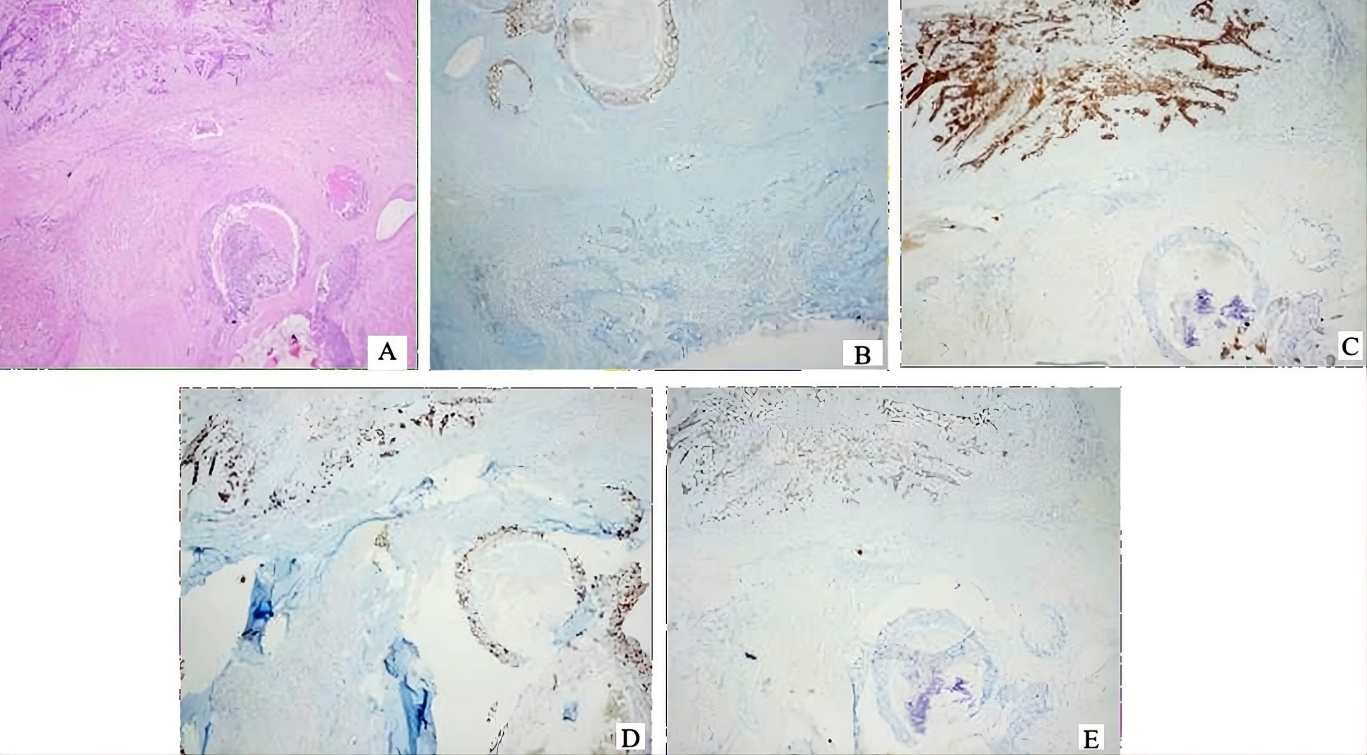
Figure 1: Representative histopathological and immunohistochemical features of high-grade salivary adenocarcinoma. (A) Hematoxylin and Eosin (H&E, 10x) section showing poorly differentiated carcinoma with solid growth and overt cytological atypia. (B) Intense, diffuse nuclear immunoreactivity for Androgen Receptor (AR) within ductal structures, with loss of expression in solid/undifferentiated components (IHC, 10x). (C) CK5/6 expression localized to the non-ductal basaloid components, highlighting the biphasic architectural distribution (IHC, 10 xs). (D) High proliferative dynamic demonstrated by a Ki67 labeling index of approximately 80%, involving both ductal and solid tumor areas (IHC, 10x). (E) p63 immunoreactivity restricted to the abluminal/basaloid cells in non-ductal areas, further confirming the diagnostic segregation from classic purely luminal ductal carcinoma (IHC, 10x).
Section
Discussion
The diagnostic landscape of salivary gland oncology in Odisha is characterized by profound morphological complexity. High-grade malignancies in this region often lack the architectural cues necessary for traditional classification, leading to their historical relegation to the ANOS "wastebasket" category [10,11]. The primary finding of this investigation is the successful reclassification of these archival ANOS cases as SDC through the systematic application of a contemporary IHC panel. In direct alignment with our specific aims, strong AR immunoreactivity within ductal structures served as the definitive diagnostic pivot [2,12]. This confirms our study's rationale: a significant portion of the high-grade salivary tumors in regional Indian centers obscures aggressive, molecularly actionable entities that remain unidentified under purely descriptive microscopy.
Clinical and Histopathological Dynamics
Our findings in this tertiary care cohort align with global demographic trends, showing a median age of 62 years and a 100% male predominance—a classic hallmark of SDC [13]. The significant involvement of the submandibular gland (40%) and the presence of PNI in 40% of cases underscore the regional aggressiveness of these high-grade adenocarcinomas [14,15]. Histopathological indicators, specifically the presence of LVI, high T-stage (T3), and an exceptionally high Ki67 index of 80%, confirm a biological profile of intense aggression [16,17].
The consistently high Ki67 index of 80% across both architectural components further underscores an aggressive, unified proliferative dynamic, regardless of the divergent phenotypic differentiation observed. While our cohort size (n=5) reflects the rarity of these malignancies, the 100% reclassification rate identifies a significant diagnostic gap within regional registries. This extreme proliferative rate (significantly exceeding the global SDC median of 37–55%) suggests that while AR-positivity provides a rationale for ADT, the biological aggression may necessitate a combined chemo-hormonal approach. In such high-proliferative variants, ADT may serve as an effective backbone to reduce tumor burden, but the rapid cell turnover indicates that traditional cytotoxic agents or emerging AR-pathway inhibitors (enzalutamide) might be required in tandem to counteract the inherent risk of rapid disease progression.
Immunophenotypic Interpretation and Therapeutic Impact
The systematic IHC audit proved transformative for clinical management. The identification of AR-positive SDC phenotypes shifts the local standard of care from generic oncology toward precision medicine. Unlike generic ANOS, AR-positive SDC is eligible for ADT using agents such as bicalutamide [18]. Interestingly, the uniform HER2 negativity observed in this cohort contrasts with the 25%–90% positivity rates reported in Western literature [15,19]. This divergence necessitates a therapeutic pivot in regional management, placing a heavier reliance on hormonal strategies and aggressive surgical intervention.
The observed biphasic staining pattern—characterized by the localization of basal markers (p63, CK5/6) to non-ductal components and strong AR expression restricted to ductal structures—was instrumental in this reclassification. This unique immunophenotype suggests that the regional SDC variants in this cohort may not represent "classic" purely luminal carcinomas. Instead, the segregation of basal and luminal markers indicates a possible origin from high-grade transformation (HGT) of a pre-existing low-grade entity, such as epithelial-myoepithelial carcinoma (EMC), or the presence of a hybrid tumor morphology. Morphologically, the non-ductal areas exhibited a solid growth pattern with significant cytological atypia, yet retained a basaloid/myoepithelial-like protein expression signature.
Strategic Implications and Limitations
Transitioning to routine IHC for high-grade salivary gland carcinomas involves increased laboratory costs; however, the opportunity cost of failing to test is the continued use of ineffective treatments. In the context of the Indian population, implementing the 5th Edition WHO criteria is essential to minimize the "NOS" category [4,8,14].
Beyond the immediate clinical implications, the systematic IHC audit utilized here serves as a reproducible diagnostic framework. By demonstrating that a targeted panel can effectively "empty" the ANOS wastebasket, we propose this protocol as a scalable model for other regional oncology centers across the Indian subcontinent. Implementing such a standardized re-evaluation process is a critical step toward minimizing descriptive "NOS" labeling, refining cancer registry data, and ensuring that patients in resource-limited settings are not excluded from the benefits of modern precision oncology.
Conclusion
This investigation underscores that immunohistochemically driven re-evaluation is essential to transcend the limitations of descriptive morphology in salivary gland oncology. By deconstructing the generic "Adenocarcinoma, NOS" category, we identified a high prevalence of AR-positive SDC within this regional cohort, highlighting a critical opportunity to transition from palliative chemotherapy to targeted ADT. Despite unique local variations like uniform HER2 negativity, the clinical mandate is clear: integrating contemporary WHO criteria and routine IHC profiling into regional tertiary care is fundamental for delivering precision oncology and improving outcomes in these aggressive malignancies.
Declaration
Funding statement
Nil
Conflict of Interest
Nil
IEC Approval
The study was performed according to ethical parameters, after receiving the IEC approval letter from AHRCC, Cuttack, Odisha, India.
Consent to participate and consent for publication
Taken
Availability of data and materials (ADM):
On request to Corresponding author
Authors' contributions
Bagmi Mishra, Pushpanjali Behera, Anup Kumar Pramanik, Subrat Kumar Samantara, Subhransu Kumar Hota, Sashibhusan Dash: Concepts, Design, Data acquisition, Definition of intellectual content, Literature search, Manuscript preparation, Manuscript editing, Manuscript review.
Bagmi Mishra, Pushpanjali Behera, Anup Kumar Pramanik & Sashibhusan Dash: Data analysis, Statistical analysis, Manuscript preparation, Manuscript editing, Manuscript review.
Acknowledgements:
Nil