Introduction
Dental caries remains one of the most prevalent oral diseases worldwide and continues to be a major cause of restoration failure due to the development of secondary caries [1]. Despite the widespread use of resin-based composites in restorative dentistry, their long-term clinical performance is frequently compromised by marginal degradation, degradation of the adhesive interface, and insufficient resistance to cariogenic challenges [2,3].
Conventional restorative materials are primarily designed to restore lost tooth structure through mechanical replacement, with minimal biological interaction with the surrounding dental tissues [2]. Consequently, they are largely unable to actively inhibit demineralization processes or promote tissue repair once placed in the oral environment. These limitations have led to increasing interest in bioactive restorative materials, which are intended to induce beneficial biological effects at the material–tooth interface while maintaining adequate mechanical performance [4].
Bioactivity in restorative dentistry is commonly associated with properties such as ion release, buffering of acidic environments, antibacterial activity, and promotion of enamel or dentin remineralization [4,5]. Restorative materials incorporating calcium- and phosphate-based fillers, bioactive glass, or ion-releasing resin matrices have demonstrated enhanced remineralization potential and improved resistance to acid-mediated degradation under laboratory conditions [5,6]. These features are particularly relevant in the prevention of secondary caries, which remains one of the primary reasons for restoration replacement [1].
Within this framework, stimuli-responsive (smart) restorative materials have emerged as a promising class of next-generation dental biomaterials. These materials are designed to respond dynamically to changes in the oral environment—such as fluctuations in pH or mechanical stress—by activating specific functional responses, including antibacterial effects, enhanced ion release, or self-healing mechanisms [7,8]. By addressing key pathways involved in restoration failure, such as bacterial biofilm activity, demineralization, and microcrack propagation, smart materials aim to improve both the durability and therapeutic potential of restorative treatments [7].
Over the past decade, research on bioactive and smart restorative materials has expanded considerably, encompassing a wide range of experimental material concepts and multifunctional strategies [6-8]. However, the majority of published studies remain predominantly in vitro, and robust in vivo and clinical evidence supporting long-term clinical superiority over conventional restorative systems is still limited [6,9]. In addition, the diversity of material designs, experimental approaches, and outcome measures has resulted in a fragmented and rapidly growing body of literature, making it challenging to identify dominant research themes and clinically relevant development trends.
Bibliometric analysis offers a systematic and quantitative approach for evaluating scientific production, collaboration patterns, and thematic structures within such complex research fields [10]. By analyzing publication outputs, citation patterns, and keyword co-occurrence networks, bibliometric methods enable an objective assessment of research trends and knowledge development over time.
Therefore, the aim of the present study was to conduct a comprehensive bibliometric analysis of global research on bioactive and stimuli-responsive restorative materials in dentistry published between 2010 and 2025. Using data retrieved from the Scopus and Web of Science databases and analyzed through bibliometric-based methods, this study sought to characterize publication and citation trends, identify leading contributors and research hubs, map major thematic structures, and highlight gaps between experimental research and clinical application.
Methods
Study Aim and Scope
The primary aim of this bibliometric study was to systematically examine global research trends, key contributors, institutional output, and thematic developments in the field of bioactive and stimuli-responsive restorative materials in dentistry. The analysis focused on publications investigating restorative materials capable of responding to environmental stimuli—such as pH changes, temperature variations, or mechanical stressand exhibiting antibacterial, remineralizing, or self-healing properties.
The study encompassed literature published between 2010 and 2025. The year 2010 was selected as the starting point to capture the period during which research on bioactive resin-based restorative materials and nano-scale functional fillers began to expand substantially in the scientific literature.
Data Sources and Search Strategy
Relevant publications were retrieved from the Scopus and Web of Science (WoS) databases. The search strategy was designed to capture studies addressing stimuli-responsive characteristics, restorative dental materials, and the dental context, and was constructed using Boolean operators.
Search terms related to stimuli-responsive properties included: “stimuli-responsive,” “smart material*,” “self-healing,” “self-healing,” “pH responsive,” “pH-sensitive,” “temperature responsive,” “thermo-responsive,” “bioactive material*,” “remineralizing,” “remineralising,” “antibacterial releasing,” and “ion releasing.”
Target restorative materials were defined using the following terms: “dental composite*,” “resin composite*,” “glass ionomer*,” “filling material*,” “restorative resin*,” “adhesive material*,” and “dental cement*.”
To ensure relevance to dentistry, the search was restricted to publications containing the terms “dentistry,” “dental,” “tooth,” “enamel,” or “dentin.”
Publications focusing on orthodontic adhesives, brackets, implants, prostheses, orthopedic materials, metallic biomaterials, bone cements, alveolar bone, periodontal membranes, and non-dental pharmaceutical or general medical applications were excluded. All database searches were conducted on October 11, 2025, providing a consistent snapshot of the literature.
Inclusion and Exclusion Criteria
Studies were included if they met the following criteria: (i) original research articles or review papers published in English; (ii) in vitro, in vivo, clinical, or material development studies; and (iii) a primary focus on restorative dental materials with bioactive or stimuli-responsive properties.
Exclusion criteria comprised studies primarily addressing orthodontic or prosthetic materials (e.g., brackets, implants, orthodontic adhesives, or prostheses), metallic or bone-oriented biomaterials (e.g., bone cement, alveolar bone, or periodontal membranes), and publications unrelated to dental applications.
Data Collection and Management
The initial search identified 575 records from Scopus and 435 records from the Web of Science database. Within the Scopus dataset, records with incomplete bibliographic information or non-indexed entries were excluded at the database level, resulting in 429 eligible Scopus publications. The cleaned Scopus dataset was subsequently merged with the WoS records, yielding a combined dataset of 864 publications.
Duplicate records were then removed using the bibliometrix package in R (remove Duplicated function; analyses conducted in RStudio 2025.05.1). Following data cleaning and deduplication, a total of 586 unique publications were retained and included in the final bibliometric analysis.
Statistical Analysis
Statistical and bibliometric analyses were performed using the bibliometrix package in R statistical software (RStudio version 2025.05.1; Posit Software, PBC, Boston, MA, USA). Descriptive bibliometric indicators—including annual publication trends, citation counts, author productivity, and country contributions—were calculated.
Network analyses such as co-authorship networks, institutional collaboration patterns, and keyword co-occurrence relationships were visualized using VOS viewer software (version 1.6.20; Centre for Science and Technology Studies, Leiden University, Leiden, Netherlands).
In addition, thematic structures within the research field were explored through keyword co-occurrence analysis, allowing identification of major research clusters and emerging topics. Bibliometric indicators including publication counts, citation frequencies, and collaboration networks were analyzed descriptively to evaluate the scientific development of the field. All analyses were conducted in accordance with established bibliometric methodological guidelines[10].
Methodological Strengths
This study adopted an interdisciplinary bibliometric approach encompassing bioactive, self-healing, and stimuli-responsive restorative materials. The focused exclusion of unrelated areas—such as implants, orthodontics, and bone biomaterials—enhanced thematic specificity. By integrating in vitro, in vivo, and clinical research outputs, the analysis provides a comprehensive overview of the field. Moreover, the methodology is fully compatible with Scopus and WoS data export formats, ensuring transparency, reproducibility, and reliability of the bibliometric findings.
Contextual content analysis was performed to support the interpretation of bibliometric findings. Highly cited publications and dominant keyword clusters were reviewed at a conceptual level to contextualize emerging research themes, without conducting a systematic narrative review or qualitative synthesis.
Ethics Statement
This study was evaluated by the Non-Interventional Clinical Research Ethics Committee of Aydın Adnan Menderes University Faculty of Dentistry. According to the committee decision dated 25 February 2026 (Decision No: 04; Protocol No: 2026/08), the study was determined not to require ethical approval, as it is a bibliometric analysis based exclusively on previously published scientific literature retrieved from publicly available databases (Scopus and Web of Science). The study did not involve human participants, patient data, or animal subjects; therefore, ethical approval and informed consent were not required. The research was conducted in accordance with standard bibliometric research practices and applicable publication ethics guidelines.
Use of Artificial Intelligence–Based Tools
During the preparation of this manuscript, the author used ChatGPT-5 solely for language editing and formatting purposes. After careful review and necessary revisions, the author remains fully responsible for all scientific content, analyses, and interpretations presented in the publication. The use of this artificial intelligence tool affected only the clarity and presentation of the text; all scientific content, data, and interpretations were produced by the author, and the artificial intelligence tool does not meet the criteria for authorship.
Results
General Characteristics of the Scientific Output
A total of 586 publications related to bioactive and smart restorative materials in dentistry were included in the final bibliometric analysis covering the period from 2010 to 2025. Of these, 482 publications (82.2%) were original research articles, while 104 publications (17.8%) were review papers, including narrative reviews, systematic reviews, and meta-analyses. This distribution indicates a clear dominance of experimental and developmental research within the field.
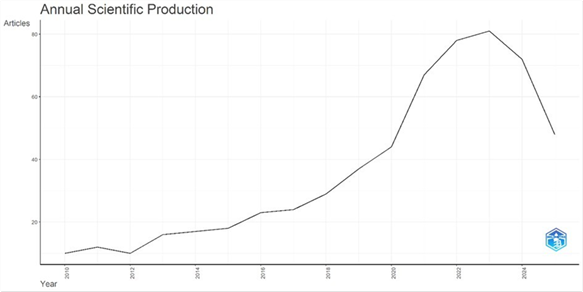
The temporal evolution of publication output demonstrates a marked and sustained growth trend (Figure 1). Annual scientific production increased from 10 publications in 2010 to 81 publications in 2025, representing more than an eightfold increase over the study period. Publication activity remained relatively limited between 2010 and 2015, followed by a steady increase from 2016 onward. A pronounced acceleration was observed after 2020, reflecting intensified global research interest in bioactive, remineralizing, antibacterial, and stimuli-responsive restorative materials.
Publication and Citation Trends Over Time
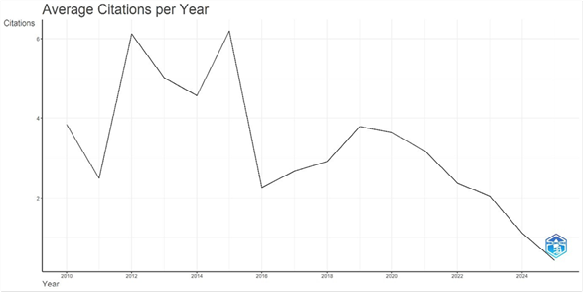
Analysis of citation patterns revealed a clear relationship between publication year and annual citation impact (Figure 2). Earlier publications (2010–2015) exhibited substantially higher average citations per year, reflecting both their foundational role in the field and longer citation windows. Notably, articles published in 2012 demonstrated the highest average citation impact, highlighting their sustained scholarly influence over time.
In contrast, publications from more recent years (2021–2025) showed lower average citations per year (Figure 2). This pattern is primarily attributable to shorter exposure times rather than diminished scientific relevance. Overall, the observed trends indicate a maturing research field that has evolved from a limited number of highly influential early studies to a rapidly expanding and diversified body of literature.
Core Journals and Source Impact
Journal-level analysis revealed that research output in this field is highly concentrated within a small number of specialized journals (Table I). Dental Materials emerged as the most productive and influential source, followed by the Journal of Dentistry, together accounting for a substantial proportion of the total publications. Other relevant sources included Dental Materials Journal, Journal of Functional Biomaterials, Materials, Polymers, and Clinical Oral Investigations, underscoring the interdisciplinary integration of restorative dentistry and materials science.
| Source | h_index | g_index | m_index | TC | NP | PY_start |
| Dental Materials | 27 | 55 | 1.588 | 3030 | 60 | 2010 |
| Journal of Dentistry | 16 | 28 | 1.231 | 890 | 47 | 2014 |
| Dental Materials Journal | 10 | 16 | 0.625 | 394 | 16 | 2011 |
| Clinical Oral Investigations | 9 | 13 | 0.692 | 290 | 13 | 2014 |
| Materials | 9 | 15 | 1.125 | 294 | 15 | 2019 |
| Polymers | 9 | 14 | 0.529 | 202 | 15 | 2010 |
| Journal of Dental Research | 8 | 8 | 0.471 | 722 | 8 | 2010 |
| Journal of Functional Biomaterials | 8 | 12 | 0.5 | 169 | 15 | 2011 |
| Acta Biomaterial | 7 | 7 | 0.412 | 432 | 7 | 2010 |
| International Journal of Molecular Sciences | 7 | 7 | 0.583 | 328 | 7 | 2015 |
a. Source: journal title
b. h-index: source-level metric indicating the number of publications (h) with at least h citations
c. g-index: source-level metric giving more weight to highly cited publications
d. m-index: h-index normalized by the number of years since the first indexed publication of the source
e. TC (Total Citations): total number of citations received by publications included in the analysis
f. NP (Number of Publications): total number of publications contributed by each journal within the dataset
g. PY_start (Publication Year Start): year of the first publication indexed for each source
h. Data source and analysis: conducted using the Bibliometrix package via its graphical interface, Biblioshiny (R software)
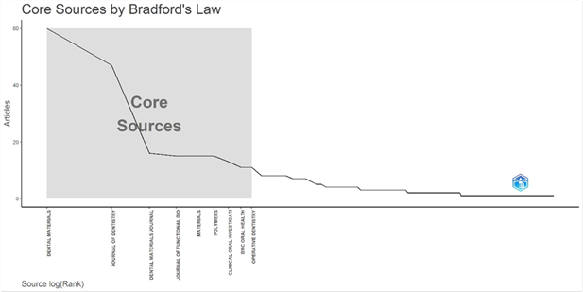
Bradford’s Law analysis further confirmed this concentration pattern (Figure 3). A limited group of core journals (Zone 1) constituted the intellectual nucleus of the field, contributing a disproportionately high share of publications. Journals classified within Zone 2 showed moderate productivity with continued thematic relevance, while Zone 3 comprised a large number of journals with sporadic contributions, reflecting the multidisciplinary diffusion of research on bioactive restorative materials.
Author Productivity, Impact, and Collaboration
Author performance analysis identified Weir, MD and Xu, HHK as the most prolific contributors, each authoring 31 publications within the dataset (Table II). Local impact indicators further highlighted Weir, MD as the most influential author in terms of h-index and total citations, followed closely by Xu, HHK Other authors, including Melo, MAS, Cheng, L, Tarle, Z., Sauro, S and Par, M demonstrated sustained productivity and substantial citation impact.
The distribution of author productivity closely followed Lotka’s Law, with more than 85% of authors contributing only a single publication, indicating a highly skewed authorship structure dominated by a small core of prolific researchers (Table II).
| Author | h_index | g_index | m_index | TC | NP | PY_start |
| Weir MD | 25 | 40 | 1.667 | 2380 | 40 | 2012 |
| Xu HHK | 21 | 31 | 1.235 | 2081 | 31 | 2010 |
| Melo MAS | 16 | 23 | 1.143 | 1222 | 23 | 2013 |
| Cheng L | 13 | 18 | 0.867 | 1464 | 18 | 2012 |
| Tarle Z | 13 | 18 | 1 | 408 | 18 | 2014 |
| Zhou X | 13 | 15 | 0.867 | 1045 | 15 | 2012 |
| Par M | 11 | 17 | 1 | 316 | 17 | 2016 |
| Marovic D | 10 | 11 | 0.769 | 221 | 11 | 2014 |
| Oates TW | 10 | 15 | 1 | 289 | 15 | 2017 |
| Sauro S | 10 | 16 | 0.714 | 514 | 16 | 2013 |
a. Author: contributing researcher(s) included in the dataset
b. h-index: author-level metric indicating the number of publications (h) with at least h citations
c. g-index: author-level metric giving more weight to highly cited publications
d. m-index: h-index normalized by the number of years since the author’s first indexed publication
e. TC (Total Citations): total number of citations received by publications included in the dataset
f. NP (Number of Publications): total number of publications contributed by each author
g. PY_start (Publication Year Start): year of the author’s first publication indexed in the analysis
h. Data source and analysis: conducted using the Bibliometrix package via its graphical interface, Biblioshiny (R software)
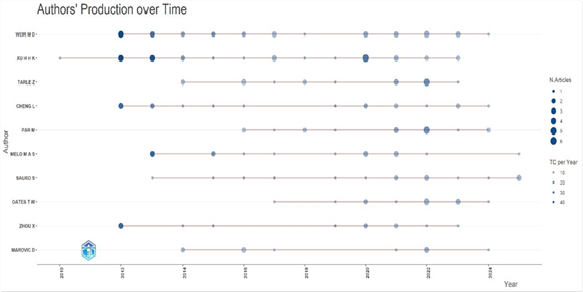
Author productivity over time revealed sustained and increasing contributions by a core group of researchers (Figure 4). Notably, authors such as Weir MD and Xu HHK demonstrated consistent publication activity throughout the analyzed period, while other influential authors, including Melo MAS, Cheng L, and Sauro S, showed a marked increase in productivity after 2015. The temporal patterns illustrated in Figure 4 highlight the presence of stable research leaders alongside emerging contributors gaining prominence in recent year.
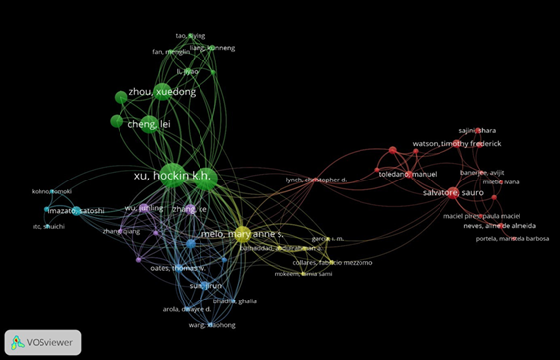
Author collaboration network analysis revealed a multicore structure characterized by several highly interconnected research clusters (Figure 5). A limited number of high-centrality authors acted as bridges between clusters, facilitating international and interdisciplinary collaboration within the field.
Institutional and Country-Level Scientific Performance
At the institutional level, the University of Maryland emerged as the most productive affiliation, followed by Sichuan University, the University of Zagreb, and the University of São Paulo (Table III). These institutions represent major research centers contributing substantially to the literature on bioactive restorative materials. The prominence of multiple dental schools and specialized academic units highlights the central role of university-based research infrastructures in advancing this field.
| Affiliation | Articles |
| University of Maryland | 168 |
| Sichuan University | 54 |
| University of Zagreb | 51 |
| University of São Paulo | 48 |
| King Saud University | 38 |
| King Abdulaziz University | 37 |
| University of Maryland School of Dentistry | 34 |
| West China School/Hospital of Stomatology, Sichuan University | 30 |
| Imam Abdulrahman Bin Faisal University | 27 |
| Universidad de Granada | 27 |
a. NP (Number of Publications): total number of publications attributed to each institution
b. Institutional names: reported as recorded in the source database and may include organizational variants
c. Data source: publications indexed in the dataset; productivity assessed based on author affiliation information
d. Data analysis: conducted using the Bibliometrix package via its graphical interface, Biblioshiny (R software)
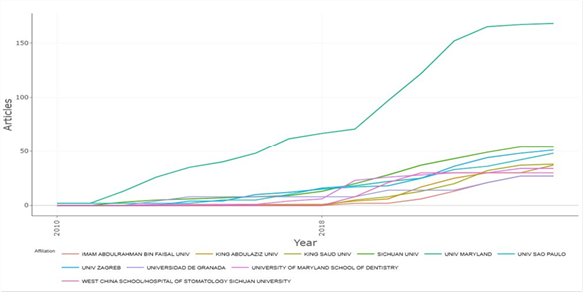
Institutional productivity analysis revealed a pronounced concentration of research output among a limited number of affiliations over time (Figure 6). The University of Maryland emerged as the leading institution, demonstrating a sharp and sustained increase in publication output, particularly after 2016. Other prominent institutions, including Sichuan University, King Saud University, and the University of São Paulo, exhibited steady growth, with notable acceleration during the later years of the analyzed period. Overall, the temporal trends indicate increasing institutional diversification alongside the dominance of a small group of highly productive academic centers.
Country-level analysis demonstrated that Brazil and the United States were the most productive countries, each contributing 50 publications (8.5%), followed by China (41 publications; 7.0%) (Table IV). The proportion of multiple-country publications was highest in Spain (81.3%), Croatia (72.7%), and the United Kingdom (65.0%), indicating strong international collaboration, whereas India exhibited exclusively single-country publications.
| Country | Articles | Articles % | SCP | MCP | MCP % |
| Brazil | 50 | 8.5 | 30 | 20 | 40 |
| USA | 50 | 8.5 | 19 | 31 | 62 |
| China | 41 | 7 | 23 | 18 | 43.9 |
| Saudi Arabia | 33 | 5.6 | 19 | 14 | 42.4 |
| Japan | 27 | 4.6 | 21 | 6 | 22.2 |
| Croatia | 22 | 3.8 | 6 | 16 | 72.7 |
| India | 20 | 3.4 | 20 | 0 | 0 |
| United Kingdom | 20 | 3.4 | 7 | 13 | 65 |
| Iran | 17 | 2.9 | 14 | 3 | 17.6 |
| Spain | 16 | 2.7 | 3 | 13 | 81.3 |
a. Articles: total number of publications contributed by each country
b. Articles (%): proportion of total publications within the dataset
c. SCP (Single-Country Publications): number of publications produced within a single country
d. MCP (Multiple-Country Publications): number of publications produced through international collaboration
e. MCP (%): proportion of internationally collaborative publications
f. Data analysis: conducted using the Bibliometrix package via its graphical interface, Biblioshiny (R software)
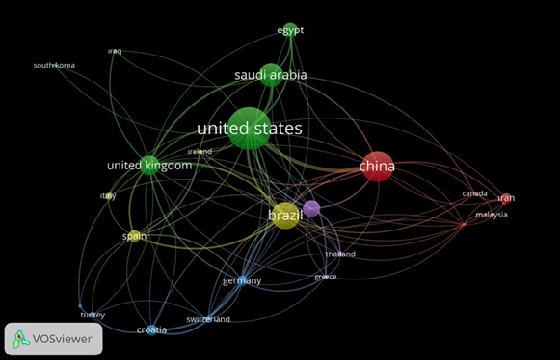
International collaboration patterns are illustrated in Figure 7. The country-level collaboration network reveals a structured configuration characterized by several highly connected hub countries. The United States occupies a central position within the network, showing extensive collaborative links with countries across multiple regions. Brazil also emerges as a prominent hub, maintaining strong collaborative connections with both European countries and Asian research partners, thereby contributing to cross-regional integration within the network. China represents another major collaboration center, forming a dense cluster with countries in Asia and the Middle East. In addition, several European countries, including the United Kingdom, Germany, France, Italy, and Spain, display strong interconnections and act as important bridging nodes linking different regional clusters. Overall, the network structure indicates that global research activity in this field is organized around a limited number of central countries that facilitate international collaboration among more peripheral contributors. Around a limited number of central countries that facilitate international collaboration among peripheral contributors.
Keyword Co-occurrence and Conceptual Structure
Keyword frequency and co-occurrence analyses revealed a well-defined conceptual structure within the field. The most frequently occurring keywords included “remineralization,” “resin composite,” “fluoride release,” “bioactive glass,” “antibacterial properties,” and “self-healing.”
VOSviewer-based network visualization identified three major thematic clusters (Figure 8). The first and most central cluster was dominated by keywords related to remineralization, including ion release, fluoride, dental caries, and tooth remineralization, representing the core biological and clinical focus of the field. The second cluster primarily encompassed bioactive materials and material–tooth interactions, with prominent terms such as bioactive glass, dentin, adhesion, bond strength, and glass ionomer cements, reflecting research on material performance and interfacial behavior. The third cluster was characterized by keywords related to advanced functional properties, including antibacterial activity, self-healing systems, microcapsules, and mechanical properties. Among all keywords, “remineralization” exhibited the highest centrality, functioning as a conceptual hub that connects material development with biological mechanisms and clinical application domains.
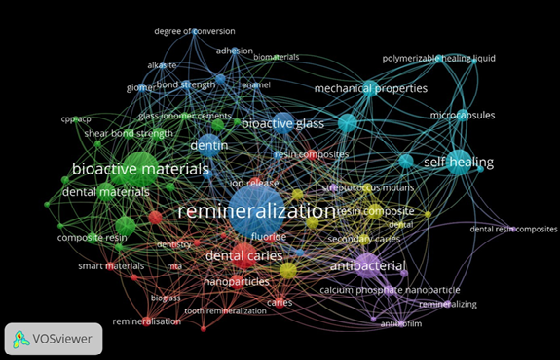
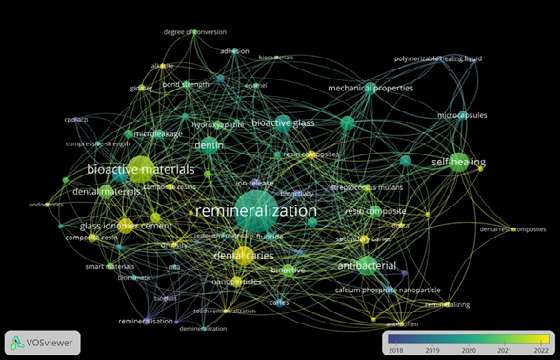
Temporal overlay analysis illustrated in Figure 9 reveals a gradual evolution of research themes over time. Earlier studies were predominantly associated with keywords related to bioactive materials, glass ionomer cements, dentin, and bond strength, whereas more recent publications increasingly emphasize remineralization, antibacterial strategies, secondary caries, nanoparticles, and self-healing systems. The color gradient indicates that these emerging topics have gained prominence particularly in the post-2019 period, reflecting a progressive shift toward biologically driven and functionally enhanced restorative approaches.
Methodological and Thematic Characteristics of the Included Studies
A comprehensive evaluation of studies investigating the bioactivity potential of restorative materials indicates that the available scientific evidence is largely based on laboratory-based experimental models, highlighting a notable gap in clinical research. The reviewed literature shows that key functional properties of bioactive restorative materialssuch as ion release, antibacterial activity, remineralization capacity, and self-healing behaviorhave been predominantly assessed using in vitro methodologies. Nevertheless, although limited in number, some studies have supported these experimental findings through the use of in vivo and in situ models.
The comprehensive literature review further demonstrates a marked increase in research interest toward biocompatible, functional, and remineralization-capable bioactive restorative materials in recent years. This growing interest is particularly evident in studies focusing on the development of “smart materials” capable of responding in a controlled manner to environmental stimuli such as stress, temperature, humidity, or pH. In parallel, an increasing number of investigations have addressed the development of multifunctional material systems that integrate antibacterial activity, remineralization potential, and self-healing capabilities within a single restorative framework. These next-generation materials are emphasized for their capacity to interact dynamically with dental tissues and support processes related to healing and regeneration.
An assessment of study design distribution reveals a clear predominance of in vitro studies within the literature, while in vivo and clinical investigations remain comparatively limited. This pattern indicates that the field continues to be driven primarily by experimental research and that high-level clinical evidence supporting the long-term effectiveness of bioactive and smart restorative materials has yet to reach a sufficient level.
Discussion
This discussion integrates quantitative bibliometric indicators with a thematic interpretation of highly cited publications to elucidate the intellectual structure and evolving research priorities in the field of bioactive and smart restorative materials. Rather than providing a comprehensive narrative review, the discussion interprets observed publication trends, keyword co-occurrence patterns, and thematic concentrations in relation to established and emerging concepts in restorative dentistry.
Growth of Scientific Output and the Emergence of a Bioactivity-Oriented Research Paradigm
The bibliometric analysis reveals a marked increase in scientific output related to bioactive and stimuli-responsive restorative materials between 2010 and 2025, with a particularly pronounced acceleration after 2020 [1,2]. This growth reflects a shift in research focus from conventional passive restorative approaches toward materials designed to interact with the oral environment and provide additional biological or therapeutic functions. In parallel, increasing attention has been directed toward materials described as “smart,” capable of responding to environmental stimuli such as pH changes, ionic fluctuations, or mechanical stress [11,12].
This transition aligns with the principles outlined in the FDI Policy Statement, which defines bioactive materials as systems capable of delivering scientifically supported, localized, and non-toxic biological effects without compromising essential mechanical and functional properties [13]. The frequent occurrence of keywords such as remineralization, antibacterial properties, fluoride release, and self-healing further indicates that this conceptual shift is consistently reflected across the bibliometric landscape [14,15].
Thematic Concentration and Conceptual Integration within the Bibliometric Landscape
Analysis of keyword co-occurrence networks demonstrates that research on bioactive and smart restorative materials is organized around several interrelated thematic domains. Among these, remineralization-related concepts represent a dominant focus, highlighting the central role of ion-mediated biological interactions in contemporary restorative material research [11]. The extensive investigation of nano-hydroxyapatite, calcium phosphate phases, and bioactive glasses reflects sustained interest in materials capable of supporting enamel and dentin through controlled ion release mechanisms [16-18]. In particular, the ability of bioactive glasses to induce hydroxyapatite formation has contributed to their prominence within both restorative and preventive research contexts [18,19].
In addition to inorganic ion-based strategies, the bibliometric findings indicate growing research attention toward biomimetic and naturally derived bioactive compounds aimed at enhancing remineralization while addressing potential toxicity concerns [20-23]. This thematic convergence provides a bibliometric explanation for the central positioning of remineralization-related keywords within the network structure.
Antibacterial functionality and environmentally responsive mechanisms constitute another major thematic concentration. Given the role of secondary caries in restoration failure, the prominence of antibacterial concepts is reflected in frequent keyword associations related to nanoparticle-based systems, ion-releasing materials, and contact-active antibacterial surfaces [24-27]. Similarly, functional monomers such as quaternary ammonium compounds appear recurrently in the literature, reflecting sustained interest in materials that combine antibacterial effects with enhanced bonding stability through the inhibition of collagen degradation [28-31]. Together, these themes illustrate a bibliometrically supported trend toward multifunctional restorative material design, particularly in caries-prone clinical scenarios [32].
Although less dominant in terms of frequency, self-healing concepts have gained increasing visibility within the bibliometric dataset [33,34]. The appearance of these keywords reflects growing interest in strategies aimed at improving restoration longevity by mitigating microcrack formation induced by mechanical and thermal stresses. Their association with adhesive systems suggests an emerging research direction focused on integrating mechanical durability with biological functionality [30].
Level of Clinical Evidence and Translational Disparities
Despite the rapid expansion of research activity, bibliometric trends indicate that the majority of studies remain laboratory-based, with limited availability of long-term clinical evidence [35]. Taken together, the bibliometric landscape reveals a persistent imbalance between laboratory-driven innovation and clinical validation in the field of bioactive and smart restorative materials. Systematic reviews and meta-analyses consistently report that bioactive resin-based materials have not yet demonstrated a clear and consistent clinical superiority over conventional composites with respect to secondary caries prevention or restoration retention [36,37].
Although clinical performance data for commercially available bioactive materials are generally encouraging, reported outcomes remain heterogeneous and highly dependent on material formulation and clinical conditions [38-43]. Variability in key clinical parameters such as marginal adaptation and microleakage further underscores the need for caution when extrapolating laboratory findings directly to routine clinical practice [9,44].
Implications and Future Directions
Overall, the present bibliometric analysis demonstrates that research on bioactive and smart restorative materials has undergone rapid quantitative expansion accompanied by increasing conceptual diversification. The scientific output is predominantly concentrated on biologically driven strategies aimed at enhancing restoration longevity, particularly through remineralization, antibacterial functionality, and multifunctional material design. These thematic concentrations reflect a clear departure from traditional replacement-oriented restorative paradigms toward biologically interactive systems intended to modulate the tooth–material interface. [9,44].
Despite this substantial growth and thematic maturity, the bibliometric landscape consistently reveals a structural imbalance between experimental innovation and clinical validation. The majority of highly cited publications are rooted in laboratory-based investigations, whereas longitudinal clinical studies and randomized controlled trials remain underrepresented. This imbalance suggests that the field is currently driven more by material development potential than by confirmed clinical effectiveness, limiting the strength of evidence supporting routine clinical adoption. [9,14,35].
From a translational perspective, the findings highlight a critical need to realign future research priorities toward clinically oriented study designs capable of validating therapeutic claims associated with bioactive and smart restorative materials. Alongside the development of such clinically oriented investigations, future research should also address the long-term balance between bioactive functionality and mechanical stability, the standardization of experimental protocols, and comprehensive assessments of biological safety. Addressing these dimensions in parallel will be essential to ensure that advances in material functionality translate into predictable and measurable improvements in clinical outcomes, thereby supporting the evidence-based integration of bioactive and smart restorative materials into routine restorative dentistry.
Study Limitations
This bibliometric study has several limitations that should be acknowledged. First, the analysis was restricted to publications indexed in Scopus and Web of Science, which may have led to the exclusion of relevant studies published in other databases, regional journals, or languages other than English. Consequently, some contributions to the field may not be fully represented in the dataset.
Second, bibliometric indicators primarily focus on quantitative measures such as publication and citation counts. While these metrics are useful for identifying research trends and influential publications, they do not necessarily reflect the methodological quality, scientific rigor, or clinical relevance of the included studies. Furthermore, citation-based indicators can be affected by factors such as publication age, journal visibility, and author prominence. As a result, older or highly cited studies may be disproportionately emphasized, whereas more recent or less visible research may be underrepresented.
Another limitation relates to the study’s scope. Research focusing on orthodontic, prosthetic, metallic, and bone-related biomaterials was excluded in order to maintain a clear focus on restorative dentistry. Although this approach helped ensure thematic consistency, it may have limited the opportunity to capture interdisciplinary perspectives and cross-disciplinary innovations in dental biomaterials research.
Finally, the dataset predominantly reflects laboratory-based and experimental investigations, providing relatively limited insight into clinical outcomes. Therefore, although this study effectively maps research trends and thematic developments within restorative dentistry, it does not provide direct evidence regarding clinical effectiveness. Caution should be exercised when extrapolating bibliometric findings to clinical practice. Future high-quality in vivo and clinical studies are required to validate the translational potential and clinical applicability of bioactive and smart restorative materials.
Conclusion
This bibliometric analysis offers a comprehensive overview of global research trends in bioactive and smart restorative materials in dentistry between 2010 and 2025. The findings reveal a rapid expansion of scientific output alongside a clear thematic concentration on remineralization, antibacterial functionality, and multifunctional material design. At the same time, the bibliometric evidence indicates that research in this field remains predominantly laboratory-based, with comparatively limited long-term clinical validation. Together, these observations highlight the need for future research efforts to place greater emphasis on well-designed clinical studies in order to support the evidence-based integration of bioactive and smart restorative materials into routine restorative dentistry.
Declarations
Acknowledgements
None
Conflict of interest declaration
The author reports no conflicts of interest.
Funding/ financial support
This study received no specific grant from any funding agency in the public, commercial, or not-for-profit sectors.
Contributors
HGD solely conceived and designed the bibliometric study, performed data retrieval, cleaning, and analysis, interpreted the findings, wrote the manuscript, and approved the final version for publication.
Ethical Clearance
Not applicable.