
Prevalence and Classification of Anemia among Patients with Gynecological Malignancies: A Prospective Observational Study from a Tertiary Cancer Institute in North India
Authors

##plugins.themes.bootstrap3.article.sidebar##
##plugins.themes.bootstrap3.article.main##
Abstract
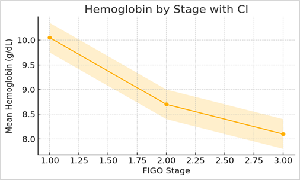
Background: Anemia is a frequent comorbidity in women with gynecological malignancies, adversely affecting tolerance to surgery, chemotherapy, and radiotherapy. Despite its clinical relevance, Indian data on its prevalence and severity patterns across tumor sites remain heterogenous. Objective: To estimate the prevalence, severity, and etiological classification of anemia among women with newly diagnosed gynecological cancers presenting for primary management. Methods: This prospective descriptive observational pilot study was conducted at a cancer institute in Noth India, from May 2023 to August 2025. Consecutive women with histologically confirmed carcinoma of the cervix, endometrium, ovary, or vulva who had not received prior treatment for cancer or anemia in the preceding six months were screened. Anemia was defined as hemoglobin < 11 g/dL (NCI 2017 criteria). Eligible participants underwent hematological evaluation including general blood picture, RBC indices, and iron profile for classification and severity grading. Results: Of 758 new gynecological cancer patients registered, 282 completed evaluation and treatment. Anemia was detected in 155 patients, giving a prevalence of 55%. Severe anemia (Hb ≤ 7 g/dL) occurred in 18%, moderate in 21%, and mild in 60.6%. Ovarian (44%) and cervical (44%) cancers were the most frequent sites associated with anemia. Advanced stage (FIGO 2B–3C) disease correlated with higher anemia prevalence. Parenteral iron therapy was more frequently administered among ovarian cancer patients, whereas blood transfusions predominated in those undergoing radiotherapy. Conclusion: Anemia is a highly prevalent comorbidity in women with gynecological cancers, particularly ovarian and cervical carcinomas, and is more pronounced in advanced disease. Routine pre-treatment screening and proactive correction of anemia are essential to optimize treatment compliance and outcomes.
##plugins.themes.bootstrap3.article.details##
Copyright (c) 2025 Dr. Priyanka Singh

This work is licensed under a Creative Commons Attribution 4.0 International License.
Creative Commons License All articles published in Annals of Medicine and Medical Sciences are licensed under a Creative Commons Attribution 4.0 International License.
Dr. Priyanka Singh, Additional Professor, Department of Gynecologic Oncology, Kalyan Singh Super Specialty Cancer Institute, Lucknow, India.
Additional Professor, Department of Gynecologic Oncology, Kalyan Singh Super Specialty Cancer Institute, Lucknow, India.
[1] National Cancer Institute. Common Terminology Criteria for Adverse Events (CTCAE) Version 5.0. Bethesda (MD): NCI; 2017.
[2] Hufnagel DH, Mehta ST, Ezekwe C, Brown AJ, Beeghly-Fadiel A, Prescott LS. Prevalence of anemia and compliance with NCCN guidelines for evaluation and treatment of anemia in patients with gynecologic cancer. J Natl Compr Canc Netw. 2021;19(5):513–520.
[3] Ludwig H, Van Belle S, Barbui T, Birgegård G, Bokemeyer C, Gascón P, et al. The European Cancer Anaemia Survey (ECAS): prevalence, incidence, and treatment of anaemia in patients receiving anti-cancer therapy. Eur J Cancer. 2004;40(15):2293–2306.
[4] Caro JJ, Salas M, Ward A, Gómez-Reyes E. Anemia as an independent prognostic factor for survival in cancer: a systematic review and meta-analysis. Cancer. 2001;91(12):2214–2221.
[5] Ministry of Health and Family Welfare, Government of India. National Family Health Survey (NFHS-5), 2019–21. New Delhi: MoHFW; 2022.
[6] Rahman S, Shukla N, Das P, Patel M. Patterns of anemia and treatment response among patients with gynecologic malignancies: a tertiary center experience. Cureus. 2023;15(2):e34721.
[7] Knight K, Wade S, Balducci L. Prevalence and outcomes of anemia in cancer: a systematic review of the literature. Cancer. 2004;101(3):421–430.
[8] Chopra S, Gupta M, Sarin R, Kannan S, Sharma SC. Impact of pretreatment anemia on outcome in carcinoma cervix patients treated with radical radiotherapy. J Cancer Res Ther. 2010;6(3):291–295.
[9] Weiss G, Goodnough LT. Anemia of chronic disease. N Engl J Med. 2005;352(10):1011–1023.
[10] Nemeth E, Ganz T. Regulation of iron metabolism by hepcidin. Blood. 2009;113(6):1390–1398.
[11] Singh P, Sharma R, Gupta R, Singh R, Yadav B. Prevalence of anemia in women with cervical carcinoma undergoing chemoradiation: a prospective analysis. Indian J Med Res. 2021;154(5):787–795.
[12] Tiwari R, Chaturvedi A, Ghosh S, Dey A. Prevalence and impact of anemia in ovarian cancer patients: an Indian cohort analysis. Indian J Med Paediatr Oncol. 2022;43(3):357–363.
[13] Singh A, Kumari S, Yadav A, Gupta N. Hematologic profile in carcinoma cervix patients undergoing chemoradiation: a tertiary center experience. J Obstet Gynaecol India. 2023;73(2):199–205.
[14] Maurya N, Sharma D, Gupta A, Singh V. Association of anemia with clinicopathologic features in gynecologic malignancies: an Indian perspective. Indian J Gynecol Oncol. 2022;20(1):12.
[15] Vaupel P, Mayer A. Hypoxia in cancer: significance and impact on clinical outcome. Cancer Metastasis Rev. 2007;26(2):225–239.
[16] ElGohary GM, Elsayed A, Khalil S, Nassar H. Global prevalence and patterns of anemia in patients with solid tumors: a systematic review and meta-analysis. Support Care Cancer. 2023;31(6):3345–3358.
[17] Rizzo M, Russo A, Capasso R, Della Pepa C, Ferrandina G. Baseline anemia and chemotherapy outcomes in epithelial ovarian cancer: an Italian multicenter experience. Gynecol Oncol. 2022;164(1):134–140.
[18] Amato A, Pescatori M. Perioperative blood transfusions and colorectal cancer recurrence: meta-analysis. Br J Surg. 2006;93(4):451–458.
[19] Auerbach M, Ballard H, Trout JR, McIlwain M, Ackerman A, Bahrain H, et al. Intravenous iron optimizes the management of anemia in cancer patients. Oncologist. 2018;23(4):456–465.
[20] Steinmetz T, Turgonyi E, Woloszczuk W, Schuster M, Hohmann C, Braun J, et al. Intravenous iron for treatment of anemia in oncology: a real-world study. Ann Oncol. 2020;31(12):1651–1660.
[21] Bohlius J, Schmidlin K, Brillant C, Schwarzer G, Trelle S, Seidenfeld J, et al. Erythropoietin or darbepoetin for patients with cancer: meta-analysis based on individual patient data. Cochrane Database Syst Rev. 2019;(12):CD003407.
[22] National Comprehensive Cancer Network (NCCN). Clinical Practice Guidelines in Oncology: Cancer-Associated Anemia. Version 3.2024. Plymouth Meeting (PA): NCCN; 2024.
[23] Indian Council of Medical Research (ICMR); Indian Cooperative Oncology Network (ICON-G). Consensus recommendations on diagnosis and management of cancer-associated anemia. Indian J Cancer. 2024;61(3):305–312.