
Incidence and Risk Factors of Retinopathy of Prematurity: A Comprehensive Clinical Study
Authors

##plugins.themes.bootstrap3.article.sidebar##
##plugins.themes.bootstrap3.article.main##
Abstract
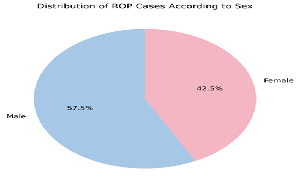
Background: Retinopathy of prematurity is a leading cause of preventable childhood blindness, primarily affecting preterm and low birth weight neonates. Aim: To determine the incidence of retinopathy of prematurity and evaluate the association between neonatal and maternal risk factors with its occurrence. Materials and Methods: A prospective observational study was conducted on 450 preterm and low birth weight neonates admitted to a tertiary care neonatal intensive care unit. The mean gestational age of the neonates was 32.6 ± 2.4 weeks, and the mean birth weight was 1.46 ± 0.31 kg. All neonates were screened for retinopathy of prematurity (ROP) using standard screening protocols. Results: In the present study, retinopathy of prematurity was identified in 40 out of 450 preterm and low birth weight neonates, resulting in an overall incidence of 8.9%, with a higher occurrence observed among neonates born at lower gestational ages and with lower birth weights. Male sex showed a slight predominance among affected infants, while maternal systemic diseases showed limited association. Conclusion: Retinopathy of prematurity remains a significant complication of prematurity, and early identification of high-risk neonates is essential for timely screening and prevention of visual morbidity.
##plugins.themes.bootstrap3.article.details##
Copyright (c) 2026 Dr. Bhavesh Govindbhai Mer, Dr. Modi Nehaben Vinodkumar, Dr. Maulika Vinodchandra Shah

This work is licensed under a Creative Commons Attribution 4.0 International License.
Creative Commons License All articles published in Annals of Medicine and Medical Sciences are licensed under a Creative Commons Attribution 4.0 International License.
[1] Blencowe H, Lawn JE, Vazquez T, Fielder A, Gilbert C. Preterm-associated visual impairment and estimates of retinopathy of prematurity at regional and global levels for 2010. Pediatr Res. 2013;74(Suppl 1):35–49.
[2] Hartnett ME, Penn JS. Mechanisms and management of retinopathy of prematurity. N Engl J Med. 2012;367(26):2515–2526.
[3] Fierson WM. Screening examination of premature infants for retinopathy of prematurity. Pediatrics. 2018;142(6):e20183061.
[4] Good WV, Hardy RJ, Dobson V, Palmer EA, Phelps DL, Quintos M, et al. The incidence and course of retinopathy of prematurity: Findings from the Early Treatment for Retinopathy of Prematurity study. Pediatrics. 2005;116(1):15–23.
[5] Saugstad OD. Oxygen and retinopathy of prematurity. J Perinatol. 2006;26(Suppl 1):S46–S50.
[6] Mitra S, Chauhan S, Roy K, Kumar P, Narang A. Risk factors for retinopathy of prematurity: A prospective observational study. Indian Pediatr. 2018;55(9):796–800.
[7] Manzoni P, Memo L, Gallo E, Villani A, Calabrese S, Meneghetti S, et al. Neonatal sepsis and retinopathy of prematurity: A systematic review and meta-analysis. Neonatology. 2013;103(4):300–308.
[8] Hellström A, Ley D, Hansen-Pupp I, Hallberg B, Löfqvist C, Smith LEH, et al. New insights into the development of retinopathy of prematurity based on improved understanding of retinal vascular growth and postnatal weight gain. Acta Paediatr. 2019;108(7):1118–1127.
[9] Quinn GE, Ying GS, Daniel E, Hildebrand PL, Ells A, Baumritter A, et al. Incidence and early course of retinopathy of prematurity. JAMA Ophthalmol. 2018;136(12):1383–1389.
[10] Vinekar A, Jayadev C, Mangalesh S, Shetty B, Vidyasagar D. Retinopathy of prematurity in Asian Indian babies weighing more than 1250 grams at birth: Ten-year data from a tertiary care center. Indian J Ophthalmol. 2017;65(5):425–430.
[11] Slidsborg C, Jensen A, Forman JL, Rasmussen S, Bangsgaard R, Fledelius HC. Neonatal risk factors for treatment-demanding retinopathy of prematurity: A Danish national study. Ophthalmology. 2018;125(11):1765–1773.
[12] Quinn GE, Dobson V, Barr C, Davis B, Flynn JT, Palmer EA. Visual acuity of eyes after stage 3 retinopathy of prematurity. Ophthalmology. 2011;118(1):74–79.
[13] Isaza G, Arora S, Bal M, Chaudhary R, Narang A. Gender differences in the incidence and severity of retinopathy of prematurity. J Neonatal Perinatal Med. 2020;13(2):213–219.
[14] Chen Y, Li X, Zhang X, Wang J, Tang S. Risk factors for retinopathy of prematurity in extremely low birth weight infants. BMC Ophthalmol. 2019;19(1):132.
[15] Kim SJ, Port AD, Swan R, Campbell JP, Chan RVP, Chiang MF. Retinopathy of prematurity: A review of risk factors and their clinical significance. Surv Ophthalmol. 2018;63(5):618–637.