
Dyslipidemia: Prevalence and Associated Risk Factors among undergraduate Students of Wellspring University, Benin City, Edo State, Nigeria
Authors

##plugins.themes.bootstrap3.article.sidebar##
##plugins.themes.bootstrap3.article.main##
Abstract
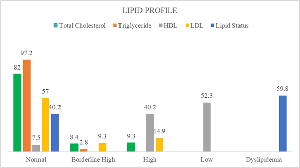
Background: Dyslipidemia, characterized by abnormal blood lipid levels, is a major risk factor for cardiovascular disease, contributing to an estimated 4.2 million deaths and disabilities globally. This study aimed to assess the prevalence and factors associated with dyslipidemia among undergraduate students of Wellspring University, Benin City, Edo State, Nigeria. Methods: A cross-sectional study was conducted among 107 undergraduates (aged 16–40 years; mean age 20.33 ± 4.14 years) at Wellspring University using purposive sampling. Sociodemographic data were collected via self-administered questionnaires. Total cholesterol (TC), triglycerides (TG), high-density lipoprotein-cholesterol (HDL-C), and low-density lipoprotein-cholesterol (LDL-C) were analyzed using a Spectrumlab MF-21D spectrophotometer. Data were analyzed with IBM-SPSS version 23.0 at p < 0.05 significance level. Results: Of the participants, 80 (74.8%) were females, and the overall prevalence of dyslipidemia was 59.8%. Prevalence of abnormal TC, HDL-C, and LDL-C were 9.3%, 52.3%, and 14.9%, respectively. There were significant associations between age and TC; access to affordable healthy food and HDL; hours of weekly physical activities and LDL (P < 0.05) respectively. Conclusion: Dyslipidemia prevalence was high among subjects. Age, physical activities and healthy food intake significantly influenced dyslipidemia. Promoting physical exercise, and healthy food consumption including fruit and vegetable may reduce dyslipidemia risk.
##plugins.themes.bootstrap3.article.details##
Copyright (c) 2026 John E. Moyegbone, Mary K. Ayanlere, Edafe O. Emurotu, Eghonghon E. Oronsaye, Prisca Onyema, Onyekach C. Madubuattah, Jennifer A. Ebeigbe, Ezekiel U. Nwose

This work is licensed under a Creative Commons Attribution 4.0 International License.
Creative Commons License All articles published in Annals of Medicine and Medical Sciences are licensed under a Creative Commons Attribution 4.0 International License.
[1] Berberich A, Hegele R. A Modern Approach to Dyslipidemia. Endocr Rev 2022;43(4):611–53.
[2] Blasco M, Ascaso J. en representación del grupo de Dislipidemia Aterogénica de la SEA. Control of the overall lipid profile. Clin Investig Arter 2019;2:34–41.
[3] World Health Organization. Cardiovascular diseases. World Heal Organ Eur [Internet] 2024;Available from: https://www.who.int/europe/news-room/fact-sheets/item/cardiovascular-diseases
[4] Gu D, Wang D, Zhu Q, Luo L, Zhang T. Prevalence of dyslipidemia and associated factors in sedentary occupational population from Shanghai: a cross-sectional study. Arch public Heal [Internet] 2024;82(1):21. Available from: https://pmc.ncbi.nlm.nih.gov/articles/PMC10854172/
[5] Mishra S, Murry B, Devi NK, Tripathi S, Suokhrie S. Obesity in dyslipidemia and hypertension: A study among young adults of Delhi/NCR. Clin Epidemiol Glob Heal [Internet] 2023; 22:101335. Available from: https://doi.org/10.1016/j.cegh.2023.101335
[6] Hamam F. Dyslipidemia and Related Risk Factors in a Saudi University Community. Food Nutr Sci [Internet] 2017;08(01):56–69. Available from: https://www.scirp.org/pdf/FNS_2017010316180322.pdf
[7] Ayoadea O, Umoh I, Amadi C. Dyslipidemia and Associated Risk Factors among Nigerians with Hypertension. Dubai Med J [Internet] 2020;3:155–161. Available from: https://karger.com/dmj/article/3/4/155/107181/Dyslipidemia-and-Associated-Risk-Factors-among
[8] Obsa MS, Ataro G, Awoke N, Jemal B, Tilahun T, Ayalew N, et al. Determinants of Dyslipidemia in Africa: A Systematic Review and Meta-Analysis. Front Cardiovasc Med [Internet] 2021;8:1–13. Available from: https://www.frontiersin.org/journals/cardiovascular-medicine/articles/10.3389/fcvm.2021.778891/full
[9] Karantas I, Okur M, Okur N, Siafaka P. Dyslipidemia Management in 2020: An Update on Diagnosis and Therapeutic Perspectives. Endocr Metab Immune Disord Drug Targets 2021;21(5):815–34.
[10] Lugo-Somolinos A, Sánchez J. Xanthomas: a marker for hyperlipidemias. Bol Asoc Med P R 2003;95(4):12–6.
[11] He H, Yu YQ, Li Y, Kou CG, Li B, Tao YC, et al. Dyslipidemia awareness, treatment, control and influence factors among adults in the Jilin province in China: a cross-sectional study. Lipids Health Dis [Internet] 2014;13:122. Available from: https://pmc.ncbi.nlm.nih.gov/articles/PMC4237893/
[12] Xia Q, Chen Y, Yu Z, Huang Z, Yang Y, Mao A, et al. Prevalence, awareness, treatment, and control of dyslipidemia in Chinese adults: a systematic review and meta-analysis. Front Cardiovasc Med [Internet] 2023;10:1–16. Available from: https://doi.org/10.3389/fcvm.2023.1186330
[13] Opoku S, Gan Y, Yobo EA, Tenkorang-Twum D, Yue W, Wang Z, et al. Awareness, treatment, control, and determinants of dyslipidemia among adults in China. Sci Rep [Internet] 2021;11(1):1–10. Available from: https://doi.org/10.1038/s41598-021-89401-2
[14] Moyegbone J, Nwose E, Anowa E, Clarke A, Odoko J, Agege A. Prevalence of Visual Impairment among Primary and Secondary School Children in Delta State, Nigeria. J Niger Optom Assoc [Internet] 2023;25(1):42–53. Available from: https://dx.doi.org/10.4314/jnoa.v25i1.7
[15] Liu LY, Aimaiti X, Zheng YY, Zhi XY, Wang ZL, Yin X, et al. Epidemic trends of dyslipidemia in young adults: a real-world study including more than 20,000 samples. Lipids Health Dis [Internet] 2023;22:108. Available from: https://doi.org/10.1186/s12944-023-01876-2
[16] Moyegbone J, Okpoghono J, Nwose E, Clarke A, Ofili C, Odoko J, et al. Anthropometric-Indices-and-Prevalence-of-Iron-Deficiency-Anaemia-among-School-Children-in-Delta-State-Nigeria-an-Intervention-Study.pdf. Acta Bulg 2024;51(2):39–48.
[17] Asaye S, Bekele S, Tolessa D, Cheneke W. Metabolic syndrome and associated factors among psychiatric patients. Diabetes Metab Syndr Clin Res Rev 2018;12(5):753–60.
[18] Livingstone KM, Dullaghan KM, Craig JM, Brayner B, McNaughton SA. Feasibility of self-administered dried blood spot collection for cardiometabolic profile analysis in a population-based sample of young adults. PLoS One [Internet] 2025;20(10):e0334023. Available from: https://doi.org/10.1371/journal.pone.0334023
[19] Randox. Randox Global Health. Available at http:// randox.com 2025;
[20] Friedewald W, Levy R, Fredrickson D. Estimation of the concentration of low-density lipoprotein cholesterol in plasma, without use of the preparative ultracentrifuge. Clin Chem 1972;18(6):499–502.
[21] Basit A, Sabir S, Riaz M, Fawwad A, Abro MUR, Ahmed KI, et al. NDSP 05: Prevalence and pattern of dyslipidemia in urban and rural areas of Pakistan; a sub analysis from second National Diabetes Survey of Pakistan (NDSP) 2016–2017. J Diabetes Metab Disord 2020;19(2):1215–25.
[22] Alhabib KF, Batais MA, Almigbal TH, Alshamiri MQ, Altaradi H, Rangarajan S, et al. Demographic, behavioral, and cardiovascular disease risk factors in the Saudi population: Results from the Prospective Urban Rural Epidemiology study (PURE-Saudi). BMC Public Health [Internet] 2020;20(1):1–14. Available from: https://pmc.ncbi.nlm.nih.gov/articles/PMC7414714/
[23] Addisu B, Bekele S, Wube TB, Hirigo AT, Cheneke W. Dyslipidemia and its associated factors among adult cardiac patients at Ambo university referral hospital, Oromia region, west Ethiopia. BMC Cardiovasc Disord [Internet] 2023;23(1):1–12. Available from: https://doi.org/10.1186/s12872-023-03348-y
[24] Mahalle N, Garg M, Naik S, Kulkarni M. Study of pattern of dyslipidemia and its correlation with cardiovascular risk factors in patients with proven coronary artery disease. Indian J Endocrinol Metab 2014;18(1):48–55.
[25] Haque A, Yusof F, Bin Arifn M, Bin Ab Hamid M, Hashim S, Haque M. Lipid profle of the Coronary heart disease (CHD) patients admitted in a hospital in Malaysia. J Appl Pharm Sci 2016;6(5):137–142.
[26] Abdelaziz A, Fawzy M. Prevalence and pattern of dyslipidemia in acute coronary syndrome patients admitted to medical intensive care unit in Zagazig University Hospital. Egypt Zagazig Univ Med J 2014;20(3):1–10.
[27] Zainel A, Al Nuaimi A, Syed M, A/Qotba H. Risk factors associated with cardiovascular diseases among adults attending the primary health care centers in Qatar, a cross-sectional study. J Community Med Public Heal 2020;4:171.
[28] Ama Moor V, NdongoAmougou S, Ombotto S, Ntone F, Wouamba D, Ngo Nonga B. Dyslipidemia in patients with a cardiovascular risk and disease at the university teaching hospital of yaoundé. Cameroon Int J Vasc Med 2017;2017:6061306.
[29] Reese JA, Roman MJ, Deen JF, Ali T, Cole SA, Devereux RB, et al. Dyslipidemia in American Indian Adolescents and Young Adults: Strong Heart Family Study. J Am Heart Assoc 2024;13(6).
[30] Hedayatnia M, Asadi Z, Zare-Feyzabadi, R Y, Aghooti-Khorasani M, Ghazizadeh H, Ghafarian-Zirak R, et al. Dyslipidemia and cardiovascular disease risk among the MASHAD study population. Lipids Heal Dis 2020;19(1):1–11.
[31] Pająk A, Szafraniec K, Polak M, Polakowska M, Kozela M, Piotrowski W, et al. Changes in the prevalence, treatment, and control of hypercholesterolemia and other dyslipidemias over 10 years in Poland: the WOBASZ study. Pol Arch Med Wewn 2016;126(9):642–52.
[32] Ali I, Kharma A, Samara M, Odeh S, Jaradat N, Zaid A, et al. Prevalence of Dyslipidemia in Undiagnosed Palestinian Men: A Cross-Sectional Study. J Lipids 2019;2019:3473042.
[33] Reiger S, Jardim T, Abrahams-Gessel S, Crowther N, Wade A, Gomez-Olive F, et al. Awareness, treatment, and control of dyslipidemia in rural South Africa: The HAALSI (Health and Aging in Africa: A Longitudinal Study of an INDEPTH Community in South Africa) study. PLoS One 2017;12(10):e0187347.
[34] Bakesiima R, Byakika-Kibwika P, Tumwine J, Al E. Dyslipidaemias in women using hormonal contraceptives: a cross-sectional study in Mulago Hospital Family Planning Clinic, Kampala, Uganda. BMJ Open 2018;8:e022338.
[35] Liu X, Yu S, Mao Z, Li Y, Zhang H, Yang K, et al. Dyslipidemia prevalence, awareness, treatment, control, and risk factors in Chinese rural population: the Henan rural cohort study. Lipids Health Dis 2018;17(1):119.
[36] Wang Y, Xu D. Effects of aerobic exercise on lipids and lipoproteins. Lipids Heal Dis 2017;16(1):132.
[37] Mosteoru S, Gaiţă L, Gaiţă D. Sport as Medicine for Dyslipidemia (and Other Risk Factors). Curr Atheroscler Rep 2023; 25:613–617.
[38] Falade O, Otemuyiwa I, Adekunle A, Adewusi S, Oluwasefunmi O. Nutrient composition of watermelon (Citrullis lanatus (Thunb.) Matsum. &Nakai) and egusi melon (Citrullus colocynthis (L.) Schrad.) seeds. Agric Conspec Sci 2020;85(1):43–9.
[39] Koller R, Agyemang C. Prevalence of cardiovascular disease risk factors in the gambia: a systematic review. Glob Hear 2020;15:42.
[40] Tsiptsios D, Leontidou E, Fountoulakis P, Ouranidis A, Matziridis A, Manolis A, et al. Association between sleep insufficiency and dyslipidemia: a cross- sectional study among Greek adults in the primary care setting. Sleep Sci 2022;15(1):49–58.
[41] Smiley A, King D, Harezlak J, Dinh P, Bidulescu A. The association between sleep duration and lipid profiles: the NHANES 2013-2014. J Diabetes Metab Disord 2019;18(2):315–322.
[42] Shin HY, Kang G, Kim SW, Kim J, Yoon J, Shin I. Associations between sleep duration and abnormal serum lipid levels: data from the Korean National Health and Nutrition Examination Survey (KNHANES). Sleep Med 2016;24:119–123.
[43] Van Den Berg J, Miedema H, Tulen J, Neven A, Hofman A, Witteman J, et al. Long sleep duration is associated with serum cholesterol in the elderly: the Rotterdam study. Psychosom Med 2008;70(9):1005–1011.