
Minimum Inhibitory Concentration (MIC) and Minimum Bactericidal Concentration (MBC) Test of Gambir Extract (Uncaria gambir Roxb.) and NaOCl Against Candida albicans as Root Canal Irrigation Material
Authors

##plugins.themes.bootstrap3.article.sidebar##
##plugins.themes.bootstrap3.article.main##
Abstract
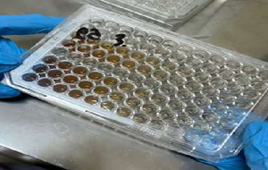
Background: Root canal treatment failure that causes re-infection can occur due to various causes, one of which is by Candida albicans fungus in the root canal. Gambir extract is a natural ingredient that can be developed as a root canal irrigation solution, this plant has many benefits and contents, such as catechin and flavonoid compounds as antibacterial and antifungal. Purpose: This study aims to determine the minimum inhibitory concentration (MIC) and minimum bactericidal concentration (MBC) of gambir extract (Uncaria gambir Roxb.) and NaOCl on the growth of Candida albicans as a root canal irrigation material. Methods: The type of experimental laboratory research on the extraction of gambir plants (Uncaria gambir Roxb.) using the maceration method, fractionation to separate active compounds in gambir (Uncaria gambir Roxb.), then the minimum inhibitory concentration (MIC) and minimum bactericidal concentration (MBC) test of gambir extract and 5% NaOCl using the broth microdilution method on 96 well plates observed with a microplate reader and the minimum bactericidal concentration (MBC) test using the spread method on agar calculated using a colony counter. Results: MIC of gambir extract (Uncaria gambir Roxb.) is 10% and MBC is 40% and MIC of NaOCl is 0,010% and MBC is 0,020%. Conclusion: Gambir extract (Uncaria gambir Roxb.) and NaOCl have effective minimum inhibitory concentration and minimum bactericidal concentration eagainst Candida albicans.
##plugins.themes.bootstrap3.article.details##
Copyright (c) 2025 Sari Dewiyani, Bani Imran, R Risky Nurainunisah, Gading Prameswari

This work is licensed under a Creative Commons Attribution 4.0 International License.
Creative Commons License All articles published in Annals of Medicine and Medical Sciences are licensed under a Creative Commons Attribution 4.0 International License.
[1] Wijayanti HN. Edukasi Kesehatan Gigi dan Mulut dalam Upaya Meningkatkan Kesehatan Gigi pada Anak Sekolah Dasar. Room Civil Societ Development. 2023;2(4):154.
[2] Departemen Kesehatan Republik Indonesia. Laporan Riskesdas 2018 Nasional. Jakarta: Kementrian Kesehatan RI: 2018.
[3] Thomas Helen, Nirupama DN, Nainan MT, Naveen DN, Ranjini CY, Vijay R. Comparative Evaluation of Antifungal Activity of Sodium Hypochlorite, Calcium Hypochlorite and modified Salt Solution associated with passive ultrasonic irrigation against Candida albicans - An In-Vitro study. Journal of Conservative Dentistry and Endodontics. 2024; 27(02): 159
[4] Tabassum S, Khan FR. Failure of Endodontic Treatment: The Usual Suspects. European Journal of Dentistry. 2016;10(1):144-147.
[5] Kashikar RR, Hindlekar A, Jadhav GR, Mittal P, Mukherjee P. Comparative Evaluation of Four Different Root Canal Irrigation Techniques for Apical Extrusion of Sodium Hypochlorite An In Vitro Study. Journal Of Conservative Dentistry and Endodontics. 2023;26(4):424-428.
[6] Gupta, Grusha, Singla, Munish, Kaur, Harleen et al. Comparative evaluation of the quality and homogeneity of different obturating systems using cone-beam computed tomography – An in vitro study. Journal of Conservative Dentistry and Endodontics. 2023. 26(04):414
[7] Alberti A, Corbella S, Taschieri S, Francetti L, Fakhruddin KS, Samaranayake LP. Fungal Species in Endodontic Infections: A Systematic Review and Meta Analysis. PLoS One. 2021;16(7):2.
[8] Tekin Betül, Demirkaya Kadriye. Natural Irrigation Solutions in Endodontics. Gulhane Medical Journal. 2020; 62(3): 133
[9] Hargreaves KM, Berman LH. Cohen’s Pathways of the Pulp. 11th ed. Elsevier;
2016:249-251
[10] Youssef AR, Al Turkistani E, Muharrij I, Alsrehi L, Shafei N, Alzahrani N. Effects of Chlorhexidine, Ethylenediaminetetraacetic Acid, and Sodium Hypochlorite on Cell Viability of Human Gingival Fibroblasts in Vitro. Saudi Endodontic J. 2020;10(3):235.
[11] Yuanita T. The Cleanliness Differences of Root Canal Walls After Irrigated with East Java Propolis Extract and Sodium Hypochlorite Solutions. Dental Journal. 2017;50(1):6-7.
[12] Katu Hafsah, Sumintarti, Mattulada Indya Kirana, Samad Rasmidar, Hatta M, As’ad S. Inhibitory Concentration and Minimum Contact Time Gambir Extract (Uncaria gambier Roxb) Against Bacterial Growth Enterococcus faecalis. International Journal of Sciences: Basic and Applied Research (IJSBAR). 2016; 27(3): 240.
[13] Ifora Ifora, Dicha Efelzita, Rezlie Bellatasie, Hendri Satria Kamal Uyun. Antifungal Potential of Purified Gambier (Uncaria gambir Roxb.). International Journal of Pharmaceutical Sciences & Medicine. 2023;8(2):40-43.
[14] Balafif FF, Soeksmanto, Dewi SRP. Antifungal Effect of Ethyl Acetate Fraction of Sarang Semut (Myrmecodia pendens Merr. & Perry). Padjadjaran Journal of Dentistry. 2022;34(3):202-209.
[15] Ulrike Binder,,Maria Aigner,Brigitte, Risslegger, Caroline Hörtnagl,Cornelia Lass-Flör, Dan Michaela Lackner. Minimal Inhibitory Concentration (MIC)-Phenomena in Candida albicans and Their Impact on the Diagnosis of Antifungal Resistance. Journal of Fungi. 2019;83(2):2-8.
[16] Vivek Devidas Mahale, Sonali Sharma. Evaluation of minimum inhibitory concentration and minimum bactericidal concentration of royal jelly against Enterococcus faecalis, Staphylococcus aureus, and Candida albicans. Jurnal of Conservative Dentistry and Endodontics. 2024;27(3):252-256.
[17] Babu P Harish, MDS, P Sameer P, MDS, Hameed Jamila, MD. Early Failures in Root Canal Treatment: A Systematic Review and Meta-Analysis. Journal Annals of Medicine and Medical Sciences (AMMS). 2025;4(4):288-289.
[18] Kamoda H, Lelyana S, Sugiaman VK. Kadar Hambat Minimum dan Kadar Bunuh Minimum Ekstrak Etanol Lengkuas Merah (Alpinia galanga L.) Terhadap Pertumbuhan Candida albicans. Jurnal Kedokteran Gigi Universitas Padjajaran.2020;32(1):3.
[19] Munggari IP, Kurnia D, Deawati Y, Julaeha E. Current Research of Phytochemical, Medicinal and Non-Medicinal Uses of Uncaria gambir Roxb.: A Review Molecules. 2022;27(19):6551
[20] Rosa Yunilda. Aktivitas Antijamur Ekstrak Etanol Daun Gambir (Uncaria gambir Roxb) terhadap Candida albicans. Jurnal Ilmu Kedokteran dan Kesehatan. 2021;8(3).
[21] Sovira Gita Dwi Jiwanda, Mariam Marry Siti, Satari Mieke Hemiawati. Antimicrobial properties of various solvents combinations for phytochemical fraction derived from Uncaria gambier extract against Enterococcus faecalis ATCC 29212. Padjajaran Journal of Dentistry. 2021; 33(1):32-38.
[22] Suraini, Chairani, Enlita. Uji Aktivitas Antijamur Ekstrak Gambir terhadap Candida albicans Secara In Vitro. Scienta Jurnal Farmasi dan Kesehatan. 2015;2(5):62.
[23] Anumedha Sharma, Nena Naorem, Binita Srivastava, Nindhi Gupta, Bidya Konsam dan Khustar Haider. Comparative Evaluation of Antifungal Efficacy of 3% Sodium Hypochlorite, 2% Chlorhexidine Gluconate, Ozonated Water, Alum Water, and Normal Saline Solutions against Endodontopathogenic Microorganism, Candida albicans: A Microbiological In Vitro Study. International Journal of Clinical Pedriatric Dentistry. 2024.17(1):20-23.
[24] Soniya R, Savithri S, Sangeetha R dan Sridevi G. In-vitro Antimicrobial Activity of Mtad, Photoactivated Disinfection Along with Chlorohexidine on Enterococcus faecalis, Staphylococcus aureus and Candida albicans. Journal Pharmacy and Technology. 2024. 17(8). 3752-3756