
To Comparative Study of Continuous Intermittent Crossed Versus Continuous Suturing Techniques for Linea Alba Closure in Midline Exploratory Laparotomy at a Tertiary Care Centre
Authors

##plugins.themes.bootstrap3.article.sidebar##
##plugins.themes.bootstrap3.article.main##
Abstract
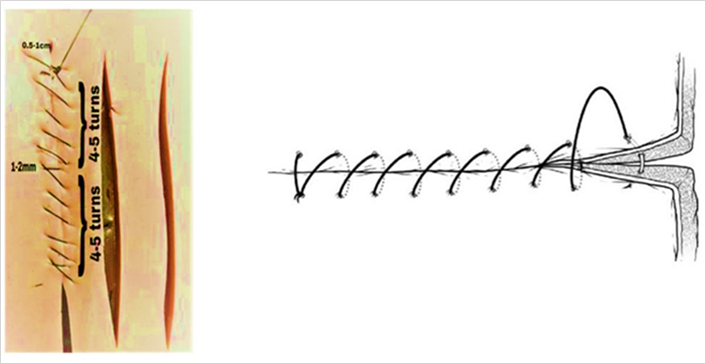
Objective: This study evaluates intraoperative closure parameters and short-term postoperative outcomes comparing continuous intermittent crossed suturing to continuous suturing techniques for linea alba closure in midline exploratory laparotomy. Methods: This prospective randomized study total 60 patients undergoing midline exploratory laparotomy, divided into two equal groups: Group A underwent linea alba closure using continuous intermittent crossing suturing, while Group B received continuous suturing. Key metrics documented included baseline demographics, intraoperative closure duration, suture lengths, suture-to-wound length (S/W) ratio, and postoperative wound complications such as infection and dehiscence. Results: Total 60 patients 30 in each group. Male predominance in both groups, with females making up 30% in Group A and 33.33% in Group B, while males constituted 70% and 66.67%, respectively. The study compared two groups, Group A and Group B, with mean ages of 35.45± 13.54 years and 37.63± 16.77 years, respectively (p = 0.688). Group A had a slightly longer closure time averaging 24.88 ± 4.52 seconds compared to 22.38± 6.52 seconds in Group B (p = 0.68). Other parameters, including suture length, wound length, and the suture-to-wound ratio, showed no significant differences between the groups (p>0.05). Additionally, wound infection occurred in 16.67% of patients in both groups, while wound dehiscence was noted in 6.67% of patients in each cohort. Conclusion: Both wound closure methods assessed yielded similar short-term results. Continuous suturing led to slightly faster closure times, while continuous intermittent crossing suturing is also a viable choice, notably in high-risk cases. Further studies are needed to evaluate the rates of incisional hernias.
##plugins.themes.bootstrap3.article.details##
Copyright (c) 2025 Amit Kumar, Brijesh Kumar Shukla, Rajdeep Singh

This work is licensed under a Creative Commons Attribution 4.0 International License.
Creative Commons License All articles published in Annals of Medicine and Medical Sciences are licensed under a Creative Commons Attribution 4.0 International License.
[1] Barrow E, Anderson ID, Varley S, Pichel AC, Peden CJ, Saunders DI, Murray D. Current UK practice in emergency laparotomy. Ann R Coll Surg Engl. 2013 Nov;95(8):599-603.
[2] Burger JW, van 't Riet M, Jeekel J. Abdominal incisions: techniques and postoperative complications. Scand J Surg. 2002;91(4):315-21
[3] Millbourn D, Cengiz Y, Israelsson LA. Effect of stitch length on wound complications after closure of midline incisions: a randomized controlled trial. Arch Surg. 2009 Nov;144(11):1056-9. doi: 10.1001/archsurg.2009.189. PMID: 19917943.
[4] Harries RL, Cornish J, Bosanquet D, Rees B, Horwood J, Islam S, et al. Hughes Abdominal Repair Trial (HART)-abdominal wall closure techniques to reduce the incidence of incisional hernias: feasibility trial for a multicentre, pragmatic, randomised controlled trial. Br Med J Open. 2017;7(12):e017235
[5] Israelsson LA, Millbourn D. Prevention of incisional hernias: how to close a midline incision. Surg Clin North Am. 2013 Oct;93(5):1027-40. doi: 10.1016/j.suc.2013.06.009. PMID: 24035074.
[6] van 't Riet M, Steyerberg EW, Nellensteyn J, Bonjer HJ, Jeekel J. Meta-analysis of techniques for closure of midline abdominal incisions. Br J Surg. 2002 Nov;89(11):1350-6. doi: 10.1046/j.1365-2168.2002.02258.x. PMID: 12390373.
[7] Seiler CM, Bruckner T, Diener MK, Papyan A, Golcher H, Seidlmayer C, Franck A, Kieser M, Büchler MW, Knaebel HP. Interrupted or continuous slowly absorbable sutures for closure of primary elective midline abdominal incisions: a multicenter randomized trial (INSECT: ISRCTN24023541). Ann Surg. 2009 Apr;249(4):576-82. doi: 10.1097/SLA.0b013e31819ec6c8. PMID: 19300233.
[8] Badkur M, Ram S, Patel S, Gupta A. Comparison between continuous vs. interrupted x-suture for midline laparotomy wound closure. Gen Surg: Open Access 2020;3(1):12.
[9] Bloemen A, De Kleijn RJCMF, Van Steensel S, Aarts F, Schreinemacher MHF, Bouvy ND. Laparotomy closure techniques: Do surgeons follow the latest guidelines? Results of a questionnaire. Int J Surg. 2019 Nov;71:110-116. doi: 10.1016/j.ijsu.2019.09.024. Epub 2019 Sep 24. PMID: 31561005.
[10] Teklewold B, Pioth D, Dana T. Magnitude of abdominal wound dehiscence and associated factors of patients who underwent abdominal operation at St. Paul's Hospital Millennium Medical College, Addis Ababa, Ethiopia. Surg Res Pract. 2020;2020:1379738.
[11] Helgeland J, Tomic O, Hansen TM, Kristoffersen DT, Hassani S, Lindahl AK. Postoperative wound dehiscence after laparotomy: a useful healthcare quality indicator? A cohort study based on Norwegian hospital administrative data. BMJ Open. 2019;9(4):e026422.
[12] Sharma G, Prashar N, Gandotra N. Comparison of suture technique (interrupted vs. continuous) with respect to wound dehiscence. Indian J Med Sci. 2020;72(3):191-4.
[13] Waqar SH, Malik ZI, Razzaq A, Abdullah MT, Shaima A, Zahid MA. Frequency and risk factors for wound dehiscence/burst abdomen in midline laparotomies. J Ayub Med Coll Abbottabad. 2005;17(4):70-3.
[14] Deerenberg EB, Harlaar JJ, Steyerberg EW, Lont HE, van Doorn HC, Heisterkamp J, et al.. Small bites versus large bites for closure of abdominal midline incisions (STITCH): a double-blind, multicentre, randomised controlled trial. Lancet. 2015 Sep 26;386(10000):1254-1260. doi: 10.1016/S0140-6736(15)60459-7. Epub 2015 Jul 15. PMID: 26188742.
[15] van den Berg R, Visscher L, Menon AG, Deerenberg EB, Tanis PJ. Suture Techniques and Materials for Fascial Closure of Abdominal Wall Incisions: A Comprehensive Meta-Analysis. Ann Surg Open. 2025 Mar 4;6(1):e548. doi: 10.1097/AS9.0000000000000548. PMID: 40134474; PMCID: PMC11932593.
[16] Roy S, Kundu K, Das S, Kuiri SS. Comparative study between continuous and interrupted suturing for rectus sheath closure in exploratory laparotomy. Asian J Med Sci. 2022;13(5):177-82.
[17] Malhotra K, Bondje S, Sklavounos A, Mortada H, Khajuria A. Absorbable versus nonabsorbable sutures for facial skin closure: a systematic review and meta-analysis of clinical and aesthetic outcomes. Arch Plast Surg. 2024;51(4):386-96.
[18] Peponis T, Bohnen JD, Muse S, Fuentes E, van der Wilden GM, Mejaddam A, et al. Interrupted versus continuous fascial closure in patients undergoing emergent laparotomy: a randomized controlled trial. J Trauma Acute Care Surg. 2018;85(3):459-65.
[19] Nasir M, Siddique M, Zaeem A, Raza A, Rizwan M, Abbas M. Comparison of continuous versus simple interrupted polypropylene suture closure of midline emergency laparotomy wound in terms of wound outcome in adult patients presenting with acute abdomen. Pak J Health Sci. 2025;6(1):283-8.
[20] Shashikala V, Abhilash SB, Abhishek G, Fernandes PS. A comparative study between continuous and x-interrupted sutures in emergency midline laparotomies. Int Surg J. 2018;5(5):1753-7.
[21] Pradhan A, Prusty N, Chand SK, Panditray S. Rectus sheath closure techniques in exploratory laparotomy: continuous versus interrupted suturing—a prospective study. J Pharm Technol Clin Pharm. 2025;32(2):673-9.
[22] Sehgal M, Mainra A, Thakur N, Chandel UK. Comparison of continuous versus interrupted X suture technique to prevent wound dehiscence after midline laparotomy—a prospective study. IOSR J Dent Med Sci. 2021;20(4):1-8.